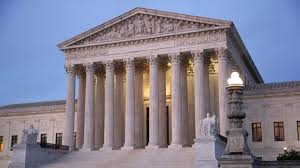
This past Monday, October 5, 2026, was the first Monday in October, and with it the Supreme Court of the United States (colloquially, “SCOTUS”) opened October Term 2026. As readers of MuseNews may recall from our earlier post, The First Monday in October & Other Supreme Court Facts, that date is not a matter of custom or chance; rather, it is fixed by statute. Below, we briefly revisit how Congress came to set the Court’s calendar and then preview ten cases worth watching this Term.
A Brief Statutory History of the Court’s Calendar
The Term begins when it does because Congress says so. Pursuant to 28 U.S.C. § 2, SCOTUS “shall hold at the seat of government a term of court commencing on the first Monday in October of each year.” The U.S. Constitution’s Judicial Vesting Clause creates “one supreme Court,” but it leaves that Court’s size, calendar, and much more of its structure to statute. U.S. Const. art. III, § 1.
That statutory calendar has moved several times:
- 1789. The Judiciary Act of 1789 fixed the bench at six Justices and required two sessions each year, beginning on the first Monday in February and the first Monday in August. Judiciary Act of 1789, ch. 20, § 1, 1 Stat. 73, 73.
- 1802. Congress abolished the August session, leaving a single annual term beginning the first Monday in February. Act of Apr. 29, 1802, ch. 31, 2 Stat. 156.
- 1826. To relieve a growing backlog, the term moved to the second Monday in January, effective in 1827. Act of May 4, 1826, ch. 37, 4 Stat. 160.
- 1844. The opening day moved to the first Monday in December. Act of June 17, 1844, ch. 96, 5 Stat. 676.
- 1873. As the post–Civil War docket swelled, the term moved to the second Monday in October. Act of Jan. 24, 1873, ch. 62, 17 Stat. 419.
- 1916. As part of legislation expanding the Court’s discretionary review, Congress moved the start date up one week to the first Monday in October. Act of Sept. 6, 1916, ch. 448, § 1, 39 Stat. 726. The change first took effect on October 1, 1917.
The modern text dates to the 1948 re-codification of Title 28. Cf. Act of June 25, 1948, ch. 646, 62 Stat. 869. Its companion provision, 28 U.S.C. § 1, sets SCOTUS’s membership at a Chief Justice and eight Associate Justices, “any six of whom shall constitute a quorum.” That number, too, is a creature of statute—it has ranged from six to ten and has stood at nine since the Judiciary Act of 1869, viz. the Constitution created the Court, but Congress built its calendar.
Ten Cases to Watch This Term
As of October 1, the Court had granted review in roughly two dozen cases for the Term, with more grants expected throughout the fall. The ten below, listed in argument order, span climate litigation, religious liberty, the Second Amendment, voting, immigration, and criminal procedure.
- Suncor Energy (U.S.A.) Inc. v. Cnty. Comm’rs, No. 25-170 (argued Oct. 5, 2026).
- Salazar v. Paramount Glob., No. 25-459 (argument scheduled Oct. 14, 2026).
- St. Mary Cath. Par. v. Roy, No. 25-581 (argument scheduled Nov. 3, 2026).
- Dep’t of Labor v. Sun Valley Orchards, LLC, No. 25-966 (argument scheduled Nov. 10, 2026).
- Viramontes v. Cook Cnty., No. 25-238, consol. with Grant v. Higgins, No. 25-566 (argument scheduled Dec. 2, 2026).
- Int’l Partners for Ethical Care, Inc. v. Ferguson, No. 25-840 (argument scheduled Dec. 7, 2026).
- Republican Nat’l Comm. v. Mi Familia Vote, No. 25-1017 (argument scheduled Dec. 8, 2026).
- Dep’t of Homeland Sec. v. D.V.D., No. 26-426 (argument scheduled Dec. 9, 2026).
- Rhoney v. Barbosa da Cunha, No. 26-104 (cert. granted Oct. 1, 2026).
- Kian v. Florida, No. 26-6623 (cert. granted June 15, 2026).
Following the Term
The Court’s own website remains the best free starting point: each case’s docket page links the petition, merits briefs, and amicus filings, and the argument calendars post the schedule for each sitting. Same-day argument audio and transcripts appear under Oral Arguments.
