Arachnophonia: Dolly Parton “Jolene”

Editor’s note: Arachnophonia (“Arachno” = spider / “-phonia” = sound) is a regular feature on our blog where members of the UR community can share their thoughts about resources from the Parsons Music Library‘s collection.

All links included in these posts will take you to either the library catalog record for the item in question or to additional relevant information from around the web.

Today’s installment of Arachnophonia is by student assistant Giuliana (class of 2028) and features Dolly Parton’s 1974 album Jolene. Thanks, Giuliana!

Dolly Parton

Jolene

Dolly Parton - Jolene album cover

Dolly Parton’s 1974 album, Jolene, is one of my favorites. It is a great set of songs for people that want country with more of a pop feel. I love how Dolly conveys a story in each one, while also making them feel personal in a way through the emotion that she puts into them. For example, “Jolene,” “I Will Always Love You,” and “Cracker Jack” demonstrate a sample of the versatility within this album. Ranging from pleading, to declarations of love, and then playfulness, the songs relate to the listeners’ feelings and prove that she is a storyteller, not just a songwriter. She tries and succeeds to capture a full spectrum of honest emotions.

I believe this album is a staple and important to take note of because Dolly Parton is one of the most influential and successful female artists of her time. She especially shaped the voice of women in country music, proving that they could be both successful and creatively independent. Her authenticity and uniqueness asserted herself as a woman in a male dominated field, and created a legacy that will influence generations to come. Even today she is setting new standards; in 2022 she was inducted into the Rock & Roll Hall of Fame, but to prove to herself that she earned it, she stepped outside of her comfort zone and created a full rock album, a desire that she has had for a long time!

Arachnophonia: Rachmaninoff “Piano Concerto No. 2, op. 18 – Six Preludes”

Editor’s note: Arachnophonia (“Arachno” = spider / “-phonia” = sound) is a regular feature on our blog where members of the UR community can share their thoughts about resources from the Parsons Music Library‘s collection.

All links included in these posts will take you to either the library catalog record for the item in question or to additional relevant information from around the web.

Today’s installment of Arachnophonia is by student manager Alexandra (class of 2026) and features a Rachmaninoff piano concerto and preludes on vinyl. Thanks, Alex!

Sergei Rachmaninoff

Piano Concerto no. 2, in C minor, op. 18 + Six preludes

Rachmaninoff - Piano Concerto no. 2 & 6 Preludes

Sergei Rachmaninoff was a Russian composer and pianist whose works stand among the most emotionally powerful in the late Romantic tradition. Born in 1873, Rachmaninoff suffered a devastating crisis of confidence after the poor reception of his First Symphony in 1897, falling into a prolonged creative silence. With the help of hypnotherapy from Dr. Nikolai Dahl, he gradually recovered his confidence and began composing again. The result was the Piano Concerto No. 2 in C Minor, Op. 18, completed in 1901, a triumphant return that would become one of the most beloved works in the concerto repertoire. The piece opens with an iconic series of tolling piano chords that build to a sweeping orchestral entrance, immediately establishing the concerto’s character of brooding grandeur and soaring lyricism.

The first movement, I. Moderato introduces the main themes with the piano and orchestra in deep dialogue. The piano’s opening chords, unusual for their time in starting without orchestral introduction, give way to sweeping, lyrical lines that alternate between melancholy and urgency. Rachmaninoff’s gift for long, arching melody is on full display, with the piano and strings exchanging themes of aching beauty. The second movement, II. Adagio sostenuto, is the emotional heart of the concerto. A serene, almost hymn-like theme unfolds over a murmuring piano accompaniment, then builds to a passionate climax and retreats into a quiet resolution. The third movement, III. Allegro scherzando, bursts with energy and rhythmic drive, revisiting themes from the first movement and building to a heroic, triumphant conclusion that showcases both the soloist and the full orchestra at their most brilliant.

This particular recording, pressed on vinyl as DGM 12036, features the legendary Soviet pianist Sviatoslav Richter, widely considered one of the greatest interpreters of the Romantic piano repertoire. Conducting is Stanisław Wisłocki at the helm of the Warsaw Philharmonic Orchestra (Filharmonia Narodowa). Recorded in 1960, the performance is celebrated for Richter’s extraordinary blend of architectural clarity and deep emotional commitment; his playing is never indulgent, yet fully alive to every surge of Rachmaninoff’s feeling. The six Preludes on the second side of the vinyl offer an intimate counterpart to the concerto, revealing Rachmaninoff as a master of concentrated expression, each prelude a small world of its own.

Overall, Rachmaninoff’s Piano Concerto No. 2 stands as a monument of the late Romantic era and a testament to the composer’s resilience and artistic depth. It has since become one of the most performed and recorded concertos in the classical canon, and Richter’s 1960 interpretation remains a gold standard. Richter himself was known for his refusal to play to the crowd. He once said he saw himself as a servant of the composer rather than a showman. In this recording, that philosophy yields something rare: a performance that feels both inevitable and alive, as if Rachmaninoff’s own voice speaks through every note.

Parsons Playlists: Spring Walks

Welcome back to Parsons Playlists! Today’s playlist is curated by Music Library student assistant Elina (class of 2029) and features some music for springtime walking.

Spring Walks

UR spring walk with lake and cherry blossoms

This playlist has that effortless main-character vibe, and it is perfect for spring walks around campus or wandering through nature.

Carnival Youth – “Never Have Enough”

Declan McKenna – “Brazil”

alt-J – “Breezeblocks”

Milky Chance – “Stolen Dance”

Hozier – “Would That I”

Bakar – “Hell N Back”

The Drums – “Money”

Radiohead – “Weird Fishes”

Richy Mitch & The Coal Miners – “Evergreen”

Her’s – “What Once Was”

Harmless – “Swing Lynn”

Mac DeMarco – “Still Beating”

The Smiths – “There Is a Light That Never Goes Out”

Wallows – “Remember When”

Here is a link to the whole playlist on YouTube:

WDCE Charts 3-25-26

WDCE 90.1 Logo

WDCE 90.1: UR Radio is the voice of independent radio in Richmond, VA and has been student-run and operated since 1960.
Students have used it as a launching pad for careers in radio or other mass communications, and also as an engaging extra-curricular activity. Community members and UR alumni also continue to play an important role in the station.

We’re sharing chart information from WDCE as reported to the North American College and Community (NACC) Radio Chart.

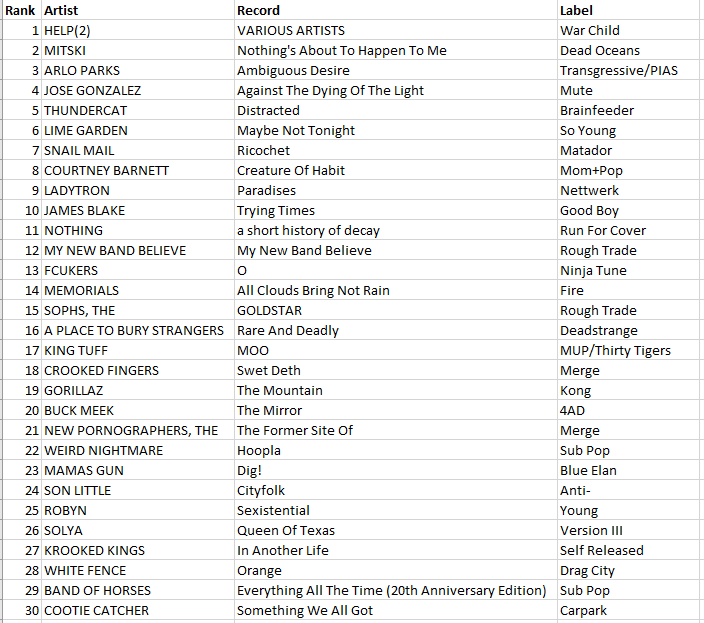
Here’s the WDCE Top 30 from 25 March 2026 (click the image to see a larger version):

WDCE chart 3-25-26

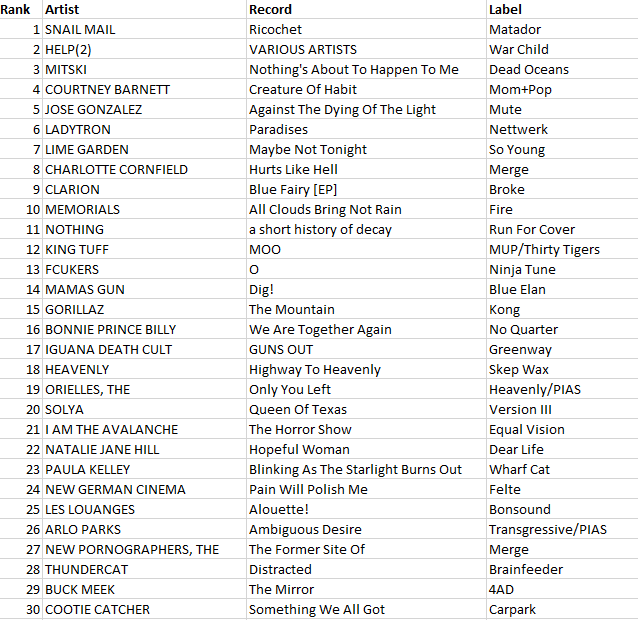
For comparison, here is this week’s national NACC chart (click the image to see a larger version):

NACC chart 3-25-26

You can stream WDCE live here: https://live365.com/station/WDCE-90-1-FM-a39711

WDCE Collage 3-25-26

The top four albums played on WDCE this week were:
* Various Artists – Help(2)
* Mitski – Nothing’s About to Happen to Me
* Bonnie Prince Billy – We Are Together Again
* Nothing – A Short History of Decay

Arachnophonia: Samara Joy “Portrait”

Editor’s note: Arachnophonia (“Arachno” = spider / “-phonia” = sound) is a regular feature on our blog where members of the UR community can share their thoughts about resources from the Parsons Music Library‘s collection.

All links included in these posts will take you to either the library catalog record for the item in question or to additional relevant information from around the web.

Today’s installment of Arachnophonia is by student manager Susanne (class of 2026) and features Samara Joy’s 2024 album Portrait. Thanks, Susanne!

Samara Joy

Portrait

Samara Joy - Portrait (album cover)

If you’re in the mood for something warm, timeless, and smooth on the ears, Portrait by Samara Joy is the kind of record you can sink into. The album leans into classic jazz tradition with standards and old-school arrangements, but it doesn’t feel stuck in the past. Joy’s voice has this effortless clarity and control that makes every song feel intimate, like she’s singing right across the room from you. There’s a sense of confidence and ease in Joy’s sound and artistic choices that makes the whole album feel inviting.

Portrait is especially charming because of how personal it feels. Even though many of the songs are standards, Joy approaches them like she’s gently reshaping them to fit her own story and style. The arrangements are rich but never overwhelming, giving her voice plenty of space to shine, and the overall vibe is cozy, familiar, and reflective. I found that it’s the kind of album I like to put on when I want to slow down a bit and just let the music wrap around me. The vinyl is available at Parsons Music Library, so definitely go check it out!

Samara-Joy-by-Ambe-J.-Williams

Arachnophonia: Michael Jackson “Thriller”

Editor’s note: Arachnophonia (“Arachno” = spider / “-phonia” = sound) is a regular feature on our blog where members of the UR community can share their thoughts about resources from the Parsons Music Library‘s collection.

All links included in these posts will take you to either the library catalog record for the item in question or to additional relevant information from around the web.

Today’s installment of Arachnophonia is by student manager Eliana (class of 2026) and features MIchael Jackson’s 1982 album Thriller. Thanks, Eliana!

Michael Jackson

Thriller

Michael Jackson - Thriller album cover

Michael Jackson is one of those timeless artists that crosses generations of listeners. There are few people that I have met that say they have not listened to him, and if they say they are unaware what songs he has made, it is likely they just had no idea who wrote the song. Winning 13 Grammy Awards over his lifetime, Michael was widely recognized as the “King of Pop.” 8 of those Grammy Awards went to his album Thriller in 1984, and to this day he remains one of the record holders for most Grammy Awards won in a single night.

Thriller is Michael’s 6th studio album, and it remains the best-selling album of all time to this day. One of its tracks, “Beat It,” won Record of the Year in 1982 alongside his other awards. This album contains many fan favorites, including the well-known “Thriller” and “Billie Jean.” One of my favorites is “The Girl is Mine” featuring Paul McCartney. This soft pop ballad reminds me of Michael’s early Motown era, serenading the world with songs of love. Michael’s passing in 2009 shook the world, but his influence continues to live on through his music. The Thriller album is sure to get you bobbing your head without you even noticing, so be sure to take a listen to the vinyl (or on CD) at the Parsons Music Library!

Parsons Playlists: Spring

Welcome back to Parsons Playlists! Today’s playlist is curated by Music Library student assistant Giuliana (class of 2028) and features some songs for spring.

Spring

This is a playlist that is perfect for spring time and the warm weather that is right around the corner. These songs feel more carefree and capture the sunny days that make you want to spend time outside. I love listening to music that makes me feel excited for the days ahead of me, so hopefully this playlist will do the same for others!

The Mamas and the Papas – “California Dreamin'”

Fleetwood Mac – “The Chain”

Olivia Dean – “Dive”

First Aid Kit – “Emmylou”

Tears for Fears – “Everybody Wants to Rule the World”

Hozier – “From Eden”

Macklemore – “Glorious”

Macklemore – “White Walls”

SZA – “Good Days”

Good Neighbours – “Home”

Hozier – “Jackie and Wilson”

The Cranberries – “Linger”

Here is a link to the whole playlist on YouTube:

WDCE Charts 3-18-26

WDCE 90.1 Logo

WDCE 90.1: UR Radio is the voice of independent radio in Richmond, VA and has been student-run and operated since 1960.
Students have used it as a launching pad for careers in radio or other mass communications, and also as an engaging extra-curricular activity. Community members and UR alumni also continue to play an important role in the station.

We’re sharing chart information from WDCE as reported to the North American College and Community (NACC) Radio Chart.

Here’s the WDCE Top 30 from 18 March 2026 (click the image to see a larger version):

WDCE chart 3-18-26

For comparison, here is this week’s national NACC chart (click the image to see a larger version):

NACC chart 3-18-26

You can stream WDCE live here: https://live365.com/station/WDCE-90-1-FM-a39711

WDCE Collage 3-18-26

The top four albums played on WDCE this week were:
* Various Artists – Help(2)
* Mitski – Nothing’s About to Happen to Me
* Remember Sports – The Refrigerator
* Nothing – A Short History of Decay

Arachnophonia: Ravel’s “Boléro”

Editor’s note: Arachnophonia (“Arachno” = spider / “-phonia” = sound) is a regular feature on our blog where members of the UR community can share their thoughts about resources from the Parsons Music Library‘s collection.

All links included in these posts will take you to either the library catalog record for the item in question or to additional relevant information from around the web.

Today’s installment of Arachnophonia is by student manager Alexandra (class of 2026) and features the score for Maurice Ravel’s “Bolero”. Thanks, Alex!

Maurice Ravel

Boléro

Maurice Ravel was a French composer who epitomized early 20th-century musical innovation, blending impressionism with striking originality. His most famous work, Boléro, premiered in 1928 at the Paris Opéra, mesmerizing audiences with its hypnotic repetition and orchestral ingenuity. Despite critics initially dismissing it as monotonous, Ravel created a masterpiece that demonstrated how a single, unchanging melody could build dramatic tension through orchestration alone. The overwhelming success of Boléro established Ravel as a master of orchestral color, proving that innovation need not rely on harmonic complexity.

Boléro is a one-movement orchestral work lasting approximately fifteen minutes, built entirely on two alternating melodic themes in C major that repeat eighteen times without variation. The piece maintains an unwavering snare drum rhythm pattern throughout, a bolero rhythm borrowed from Spanish dance music. What begins as a barely audible melody played by a solo flute gradually transforms into a thunderous orchestral climax as Ravel systematically adds instruments in carefully calculated combinations. The genius lies in the kaleidoscope of instrumental colors he employs—from delicate piccolo and celesta to robust trombones and tubas. The relentless crescendo, spanning from pianissimo to fortissimo, builds inexorable momentum until the final, shocking modulation to E major releases the accumulated tension.

Ravel himself described Boléro as “orchestral tissue without music,” concerned that audiences would tire of its repetitive nature. Yet the work’s hypnotic power captivated listeners, becoming his most performed composition. The Spanish dancer Ida Rubinstein commissioned the piece as a ballet, and Ravel drew inspiration from the mechanical, trance-like quality of factory machinery. His meticulous orchestration transforms a simple dance rhythm into an exploration of pure sound, demonstrating that musical development can occur through timbre and dynamics rather than harmonic variation.

Overall, Ravel’s audacious Boléro remains one of the most recognizable works in the orchestral repertoire, its singular vision of gradual orchestral accumulation influencing composers and captivating audiences for nearly a century.

Arachnophonia: Tame Impala “Currents”

Editor’s note: Arachnophonia (“Arachno” = spider / “-phonia” = sound) is a regular feature on our blog where members of the UR community can share their thoughts about resources from the Parsons Music Library‘s collection.

All links included in these posts will take you to either the library catalog record for the item in question or to additional relevant information from around the web.

Today’s installment of Arachnophonia is by student manager Susanne (class of 2026) and features Tame Impala’s third studio album Currents. Thanks, Susanne!

Tame Impala

Currents

Tame Impala - "Currents" album cover

Tame Impala’s 2015 album Currents feels like the sound of someone who is mid-transformation. Kevin Parker traded in a lot of the psychedelic guitar sounds from earlier records for more R&B-influenced rhythms, pulsing basslines, and disco-esque dancing songs.

Underneath the shiny production is a super personal record about change: falling out of love, figuring yourself out, and realizing you’re not the same person you used to be. Tracks like “Let It Happen” and “Eventually” feel like emotional checkpoints, while “The Less I Know the Better” somehow turns awkward heartbreak into the perfect indie-dance anthem. The swirling, vortex-inspired artwork on the album captures the sense of motion and evolution throughout the tracks.

What makes Currents stick out to me is how human it feels despite all the polished production. Parker recorded most of it himself, and you can hear that obsessive attention to detail in every sound, beat, and vocal. It’s an album about letting go of control while also carefully crafting every sound, which is a contradiction that works kind of beautifully. Years later, it still feels like the perfect soundtrack for big life shifts: moving on, growing up, or just sitting with the weird mix of excitement and sadness that comes with change.