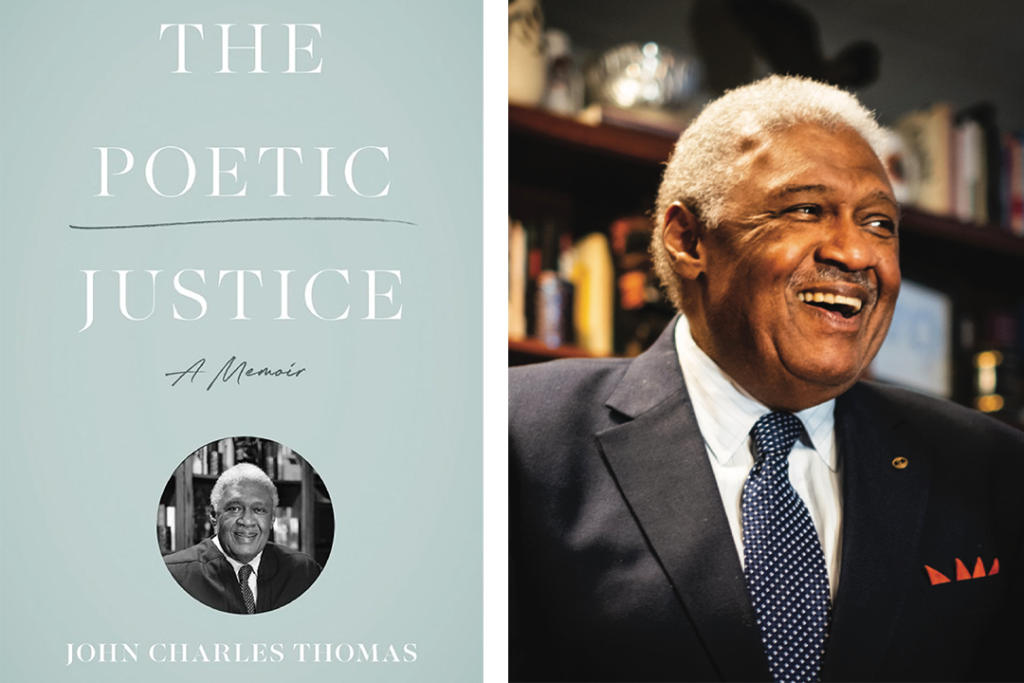
Former Supreme Court of Virginia Justice John Charles Thomas is a trailblazer in Virginia’s legal history, a staunch social justice advocate, and an accomplished poet.
Judge Thomas earned his B.A. in American government in 1972 and his J.D. in 1975, both from the University of Virginia. Following law school, he joined Hunton & Williams and, in 1982, became the firm’s first African American partner. He was also the first Black attorney in the American South–from Virginia to Texas–to join a traditional Southern law firm straight out of law school and become a partner.
In 1983, when he was only 32 years old, Thomas was appointed to the Supreme Court of Virginia, becoming both the youngest justice in the Court’s history and its first African American justice. . Throughout his seven years on the Court, In his time as a Justice, Thomas wrote the lead opinion on over 150 cases. These opinions span across a wide range of legal issues, including contracts, wills, torts, trusts and estates, and taxation.
Judge Thomas retired from his position on the Supreme Court of Virginia in 1989 and returned to Hunton & Williams (now Hunton Andrews Kurth LLP) in Richmond, where he practiced law until his retirement. In 1995, he received the NAACP’s Lifetime Image Award; he was appointed to the Court of Arbitration for Sport in Lausanne, Switzerland in 2005, and in 2014 he was named a Distinguished Alumnus of the University of Virginia College of Arts and Sciences. In his spare time, Thomas also teaches appellate advocacy at UVA School of Law and has spoken regularly at the Law School’s annual Community Martin Luther King Jr. Celebration.
In his memoir, The Poetic Justice, Thomas chronicles his inspiring journey, from growing up in the segregated neighborhoods of postwar Norfolk to serving on the bench of Virginia’s highest court. The book recounts his personal and professional development, from his early career as a Virginia lawyer, and examines the systemic injustices and racism Thomas faced throughout his life–and succeeded in spite of. He attended school in a segregated Virginia, years before Brown v. Board of Education was implemented in the state, yet he never lost his belief in the power of education. As a poet, professor, and legal scholar, he has continued to use stories of growing up in the segregated South to show how the legal system can be used to address injustice and promote equality.
In anticipation of Judge Thomas’ visit, The University of Richmond School of Law has reviewed and published legal records and information related to cases in which he wrote the lead opinion. This is part of the ongoing Virginia Verdicts project, which aims to compile information on every case decided by the Supreme Court of Virginia throughout its history. So far, staff at the William Taylor Muse Law Library at Richmond School of Law have reviewed and published details for nearly 2,000 of the more than 20,000 cases in the project, and continues to add court records and briefs to this free, publicly accessible collection.