
Editor’s note: Arachnophonia (“Arachno” = spider / “-phonia” = sound) is a regular feature on our blog where members of the UR community can share their thoughts about resources from the Parsons Music Library‘s collection.
All links included in these posts will take you to either the library catalog record for the item in question or to additional relevant information from around the web.
Today’s installment of Arachnophonia is by student manager Alexandra (class of 2026) and features a Rachmaninoff piano concerto and preludes on vinyl. Thanks, Alex!
Piano Concerto no. 2, in C minor, op. 18 + Six preludes
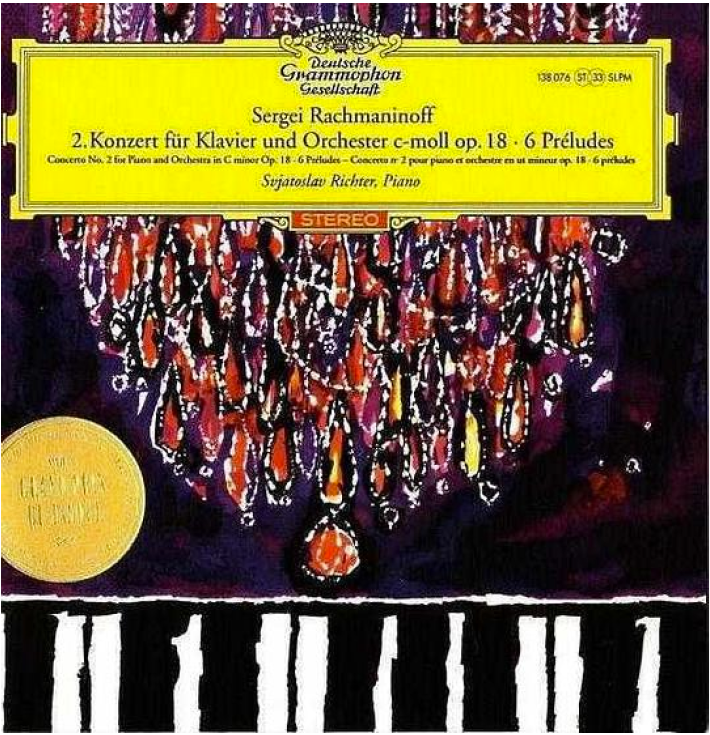
Sergei Rachmaninoff was a Russian composer and pianist whose works stand among the most emotionally powerful in the late Romantic tradition. Born in 1873, Rachmaninoff suffered a devastating crisis of confidence after the poor reception of his First Symphony in 1897, falling into a prolonged creative silence. With the help of hypnotherapy from Dr. Nikolai Dahl, he gradually recovered his confidence and began composing again. The result was the Piano Concerto No. 2 in C Minor, Op. 18, completed in 1901, a triumphant return that would become one of the most beloved works in the concerto repertoire. The piece opens with an iconic series of tolling piano chords that build to a sweeping orchestral entrance, immediately establishing the concerto’s character of brooding grandeur and soaring lyricism.
The first movement, I. Moderato introduces the main themes with the piano and orchestra in deep dialogue. The piano’s opening chords, unusual for their time in starting without orchestral introduction, give way to sweeping, lyrical lines that alternate between melancholy and urgency. Rachmaninoff’s gift for long, arching melody is on full display, with the piano and strings exchanging themes of aching beauty. The second movement, II. Adagio sostenuto, is the emotional heart of the concerto. A serene, almost hymn-like theme unfolds over a murmuring piano accompaniment, then builds to a passionate climax and retreats into a quiet resolution. The third movement, III. Allegro scherzando, bursts with energy and rhythmic drive, revisiting themes from the first movement and building to a heroic, triumphant conclusion that showcases both the soloist and the full orchestra at their most brilliant.
This particular recording, pressed on vinyl as DGM 12036, features the legendary Soviet pianist Sviatoslav Richter, widely considered one of the greatest interpreters of the Romantic piano repertoire. Conducting is Stanisław Wisłocki at the helm of the Warsaw Philharmonic Orchestra (Filharmonia Narodowa). Recorded in 1960, the performance is celebrated for Richter’s extraordinary blend of architectural clarity and deep emotional commitment; his playing is never indulgent, yet fully alive to every surge of Rachmaninoff’s feeling. The six Preludes on the second side of the vinyl offer an intimate counterpart to the concerto, revealing Rachmaninoff as a master of concentrated expression, each prelude a small world of its own.
Overall, Rachmaninoff’s Piano Concerto No. 2 stands as a monument of the late Romantic era and a testament to the composer’s resilience and artistic depth. It has since become one of the most performed and recorded concertos in the classical canon, and Richter’s 1960 interpretation remains a gold standard. Richter himself was known for his refusal to play to the crowd. He once said he saw himself as a servant of the composer rather than a showman. In this recording, that philosophy yields something rare: a performance that feels both inevitable and alive, as if Rachmaninoff’s own voice speaks through every note.