
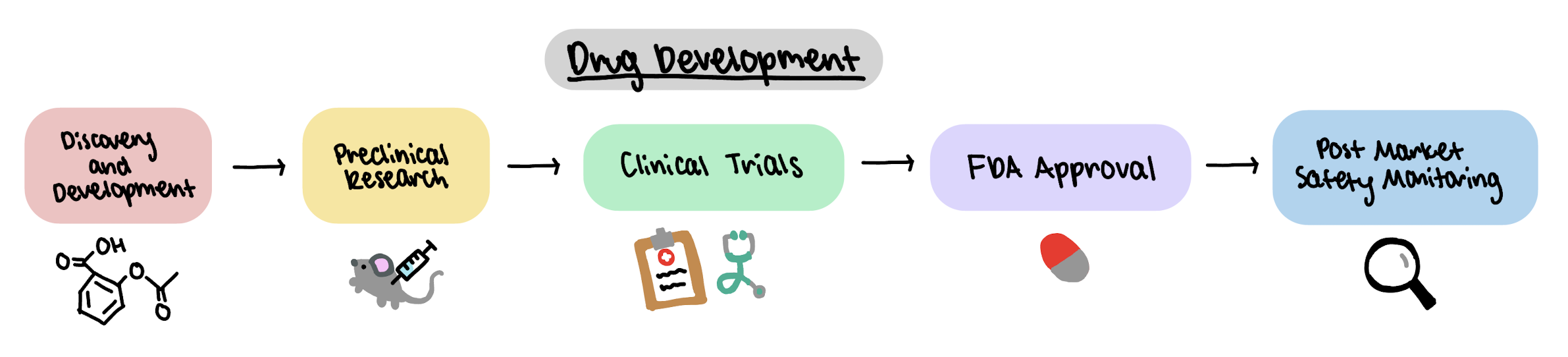
My research in the Pollock Lab involves testing compounds as inhibitors of a protein in MRSA with the goal of discovering potential antibiotic adjuvants. I find it exciting how the experiments in labs like ours can be built upon to glean more knowledge about biological systems and possibly inform the development of new drugs. Learning about the research process has sparked my interest in how prospective medications move from lab experiments to drugs prescribed to patients. Drug development requires continuous effort as drugs move through the structured pathway to be tested and approved.
Pharmaceutical research starts with the discovery and development phase. This occurs in the laboratory, where researchers determine a target of a potential drug. Then, they design and test molecules for potential effectiveness against a disease of interest. For example, the drug Trikafta is used to treat a genetic disease called cystic fibrosis, which is caused by mutations in the cystic fibrosis transmembrane conductance regulator (CFTR) protein that result in a buildup of sticky mucus in the body. This condition leads to lung damage and breathing problems, among other issues. Researchers designed Trikafta to specifically target the mutated CFTR protein and help it form the correct shape.
When researchers find promising candidates, they can acquire more information about safety through preclinical research. In this phase, researchers test potential drugs to assess toxicity and dosing information. One example of a preclinical research project is a recent study which investigated a gene therapy for the condition Fragile X Syndrome, which is a genetic disorder resulting from a genetic alteration in the Fragile X messenger ribonucleoprotein 1 (FMR1) gene that causes intellectual disability. This study involved treating mice with a gene therapy for the FMR1 gene and found that the treatment improved traits associated with the disease.
If the molecule that researchers design is found to be nontoxic, it can progress to the clinical trials phase, where the drug is tested in humans. In this phase, researchers design a study around a specific protocol, which considers conditions that patients must meet in order to qualify, how side effects will be tracked, how long the trial should occur, and the rules and schedule of the study. They also think about study design, such as if there will be a control group. For example, a recent trial on a pancreatic cancer drug called daraxonrasib involved 500 participants, 248 of whom were randomly assigned to receive daraxonrasib, and the remainder were the control group, who received the standard chemotherapy treatment. Having a control group allows researchers to compare the effectiveness of the new treatment to the typical treatment. In the case of this trial, the researchers found that daraxonrasib led to fewer serious side effects than chemotherapy. In addition, patients in the daraxonrasib group survived about twice as long as those treated with chemotherapy.
The clinical trial process starts when researchers submit an investigational new drug (IND) application to the FDA, where they describe data from the preclinical research phase about toxicity, information about how the drug is manufactured, and the protocol for the clinical trial.

In Phase 1 trials, researchers enroll about 20-100 healthy volunteers. These trials focus on determining a safe dosage for the drug, finding the effects of the drug in the human body, and recording side effects patients experience with greater doses. Patients receive frequent lab work and clinical exams as they participate in this trial phase to monitor how their body responds to the treatment.
Phase 2 trials are slightly larger, involving about one hundred patients, and focus on evaluating the effectiveness and safety for treating the condition the drug targets. Another goal of these trials is to figure out optimal doses and dosing intervals.
Phase 3 trials are larger and enroll usually more than a hundred, up to thousands of patients. They occur over the course of several years and compare the new treatment with current ones to see if it is more effective. These trials are the last step to determine if the treatment has a benefit. In addition, researchers can continue screening for potential side effects; since these trials are larger and longer, they allow for the detection of long-term or more uncommon side effects. The daraxonrasib trial that compared the survival of patients receiving the drug in comparison with those on chemotherapy was a Phase 3 trial.
After completing these trials, researchers must compile the data from the preclinical and clinical trials involving the drug and submit a New Drug Application (NDA) to the Food and Drug Administration (FDA), which outlines the results from these trials and proposes labeling information, information about safety, instructions for taking the drug, among other information. A team of experts from the FDA reviews NDAs for completion.
After the drug is on the market, the FDA continues to conduct post market safety monitoring, where they review reports of issues with drugs to ensure the safety information is kept updated. Researchers also conduct Phase 4 clinical trials, where they continue to evaluate the effectiveness and safety of the drug overtime. These trials enroll usually thousands of participants and occur for more than a year.
The drug development process helps verify that potential drugs are thoroughly assessed for efficacy and potential dangers before hitting the market for patient use. The number of drugs approved by the FDA has increased from an average of 25 drugs a year from 2000-2010 to about 50 per year from 2018 and 2024. Every successful drug requires enormous amounts of time and effort from countless individuals, including those in the research lab testing the compounds, medical professionals conducting clinical trials, FDA experts who ensure every potential drug is screened for safety, and every patient who volunteers as a participant in every stage of the clinical trial process, all with the goal of improving outcomes and quality of life for patient with various health conditions.
Natalie Small
Biology Major
Class of 2028
References
Cagan Facci, R. (2026, May 31). Multi-Selective RAS(ON) Inhibitor Nearly Doubles Survival Time in People With Metastatic Pancreatic Cancer – Multi-Selective RAS(ON) Inhibitor Nearly Doubles Survival Time in People With Metastatic Pancreatic Cancer. American Society of Clinical Oncology. Retrieved July 11, 2026, from https://www.asco.org/about-asco/press-center/multi-selective-ras-inhibitor-nearly-doubles-survival-pancreatic-cancer
CFTR Modulator Therapies. (n.d.). Cystic Fibrosis Foundation. Retrieved July 11, 2026, from https://www.cff.org/managing-cf/cftr-modulator-therapies
Clinical Trials Phases Defined. (n.d.). University of Cincinnati College of Medicine. Retrieved July 11, 2026, from https://med.uc.edu/depart/psychiatry/research/clinical-research/crm/trial-phases-1-2-3-defined
de la Torre, B. G., & Albericio, F. (2023, January 26). The Pharmaceutical Industry in 2025: An Analysis of FDA Drug Approvals from the Perspective of Molecules. Molecules, 31(3), 419. https://pmc.ncbi.nlm.nih.gov/articles/PMC12898419/#sec1-molecules-31-00419
The Drug Development Process. (2018, January 4). FDA. Retrieved July 11, 2026, from https://www.fda.gov/patients/learn-about-drug-and-device-approvals/drug-development-process
How clinical trials work. (n.d.). Pfizer. Retrieved July 11, 2026, from https://www.pfizerclinicaltrials.com/about/how-clinical-trials-work
Lacher, R. K., Henson, K., Wathen, L. N. et al. (2026, July 10). FMR1 gene therapy restores translationally relevant phenotypes in a mouse model for fragile X syndrome. Gene Therapy. https://www.nature.com/articles/s41434-026-00630-4
Recent Comments