Back to…Paper in the Classroom?

Pile of Papers

I have a penchant for mixing things up in class, if only to keep writers on their toes. For many semesters, I got away from any writing on paper in favor of blogs, digital stories, and wikis.  Now, in a literature course I last taught as paperless, some old friends (and nemeses) have returned: staples, margins, page numbers.

Why have I returned to the 20th Century?

When conducting a “paper chase” with 16 Writing Consultants and 18 literature students, I found that paper enables my Consultants to write the sort of commentary they will most likely write for our professors or in our Writing Center. In time, our faculty will embrace multimedia for many projects, but even then, Writing Consultants will need to understand the rhetoric of linear as well as associative, collaborative projects.

One could do what I’m doing with file exchanges, of course, and some faculty do just that. I’m no stranger to MS Word’s track changes and embedded comments, but even as I write this post, a student has contacted me with a question: the introduction I returned to her, with my comments linked to text, does not seem to be “working.”

I’m not fond of MS Word’s dependence upon co-writers having similar versions. I’ll probably have to switch to Google Docs to finish helping her. It’s simply a simpler, and more ubiquitous, technology. Yet even that lacks the ubiquity of paper.

Paper cannot show multimedia (yet). Paper cannot have live feedback forms or allow online tagging and collaboration (yet). Despite these limitations, I’m most curious to see how a paper-based class goes for me this term. Stay tuned.

Some tasks are, however, inefficient on paper. I’d include sign-up sheets for Writing Consultants, whether done collaboratively or with a single editor, as in this example from my current lit. class. Everyone with the link can view the document from wherever they may be. I now consider Google Docs to be “paper plus,” since they preserve what is best about linear discourse but add collaborative features that are clumsy in Microsoft Office, a technology designed for print.

And The Students Stop Blogging?

At the very time that I feel most comfortable teaching with blogs, I read that blogging is on the decline among the very demographic I teach.

I like Twitter and other sites for short notices, but few ideas can be expressed in 140 characters. Perhaps “the unexamined life is not worth living” by Socrates would fit in a Tweet. The Apology would not.

As usual, I’ll blame what I call a life of constant interruption. My Neo-Luddite side, and it is a prominent side, finds some cold comfort in the warnings of writers and thinkers such as Nicholas Carr, Mark Edmundson, and Sven Birkerts. Even tech-savvy Sherry Turkle’s book, Alone Together, warns of the shallowness of our “social” networking habits.

I look out for such writing, so I quickly ran across Gregory Palmerino’s article, “Teaching Bartleby to Write,” in the January 2011 issue of College English. Palmerino writes of his “students who would prefer not to remember to hand in writing because of their complex and distractable lives.”  Such students rarely linger in my classes after the add/drop period; the writing is plain on the syllabus about the consequences of Bartleby’s passive-aggressive preference of preferring not to do.

While I do find a kindred spirit in Palmerino, I part ways with his resistance to new technologies in the writing classroom. Blogging provides one excellent example of a type of writing that demands focus. Distraction here, in a post, can be as fatal as it would be in a short story or analytical essay.  So far, however, none of my students Tweet or use Facebook status-updates for any sort of serious discourse.  I doubt they ever will.

In print and online, we who cherish nuance and complexity in language need do something. Rejecting the new is not the answer.  So for now, my students, at least, will keep posting to blogs and replying to each other.

The Curse of the B Minus: Writers, Teachers, Failure

Creative-Commons image courtesy of targuman’s Flickr photostream

When faculty believe that they have failed as writing instructors, why do they fear that outcome? We might dread poor evaluations, angry or quiet classrooms, or–the worst fear of all–that we have let down students on their journeys to attain something like wisdom.

I say “something like” because no university education or series of excellent assignments can impart wisdom. At best, I might lead writers to see how poorly they are served by unsupported generalizations. In fact, I often try to do no more than that, plus get writers to pay attention to their own words, in the course of a semester.

Assignments might fail, even the pilot-year of  new class. But faculty members, like their students in a writing-intensive course, can learn from failure. Perhaps not enough time in graduate school goes into examining the psychology of designing assignments and conducting class, but the hard lessons of failure should be added to the curriculum. I never once did the sort of role-playing exercises that Ryan and Zimmerelli propose in their training manual for peer tutors (106-110).  Had I done so, in the presence of a faculty mentor, I might have avoided what occurred my first semester teaching writing.

It might be a counterpart to a book that is making the rounds, The Blessing of the B Minus.

At Indiana I was so terrified teaching my first class that I broke into “flop sweats” in the classroom that night in Ballantine Hall.  That got better fast, but one event sticks with me to this day. I had a student named Ellen who was a talented writer, a product of one of the best high schools in the state. But Ellen never pushed herself as hard as she might. She got an easy A on my first essay, a short diagnostic piece that counted little toward her final grade. The exercise intended to point out to me which writers had trouble with remedial issues; Ellen had none.

We Associate Instructors had been schooled in Elbow’s ideas and had read Nancy Sommers’ “Responding to Student Writing,” a 1982 masterpiece that changed my philosophy of writing commentary.  We had not, however, discussed what to do with a writer who had never before received a B- on anything. Anything.

Ellen appealed that grade, her second of the term, to me, and I patiently sat down to show her why the project did not match expectations for academic writing. She was crushed, despite my assurance that the second paper would count no more than 10 or 15 percent (I forget) of the final grade. Never before, she noted, had she gotten anything lower than an A.

She thanked me, gathered her books and papers, then left the ready-to-be-condemned building that housed the AIs. I was a terrible undergraduate until my last year, so I watched her with real puzzlement as she strode off into the Hoosier twilight.  The next class, she was absent. And the next. Indiana was not Richmond, and I had no way of letting an advisor know. There were no e-lists or other means of communications, beyond a land-line phone.

I thought the student was gone from campus, perhaps ill, until I crossed paths, literally, with her a month later. She crossed the street to avoid me, and did so again once or twice. Bloomington is a small town, so when I never saw her again, I wondered if Ellen had left the university. And was it my fault?

She got an F in Eng. 131 since she never withdrew.

Steve Sherwood’s article for writing tutors, “Apprenticed to Failure: Learning From the Students We Can’t Help” provides signal advice for teachers as well as for peer tutors. Sherwood advocates Peter Elbow’s advice that we should create “Evaluation-free zones” on our campuses (qtd. in Sherwood 53). We faculty might enable writers to practice for very low stakes, at first, in order to learn the idiosyncrasies of our academic fields or our personal preferences.

I should have done that. I should have done many things. Now I do them.

It is easy to say, and be smug while saying it, that a B- is not a life-changing experience, but I do wonder what became of Ellen.

Works Cited:

Ryan, Leigh and Lisa Zimmerelli. The Bedford Guide For Writing Tutors. New York: Bedford, 2010.

Sherwood, Steve. “Apprenticed to Failure: Learning From the Students We Can’t Help.” The Writing Center Journal 17.1 (Fall 1996): 49-57.

Academic Blogging: Impressing a Professor in 350 Words

blogging.png

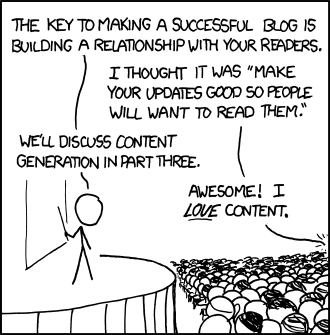
image source: Creative-Commons licensed image from xkcd

My colleagues are, increasingly, reading blogs and assigning them in classes. “Weblogs,” the full name for this medium, appear in every class I teach. I use them for weekly reading responses, warm-ups for formal writing, and even for graded multimedia projects impossible on paper.

A blog like this, rather than a closed discussion list at a course-management system like Blackboard, provides students with several real-life advantages. First, the secondary audience for a blog, one far greater than professor and classmates, enables writing for publication in the real-world Internet, rather than what we techies often call a “walled garden.” Second, blogs resemble the sorts of collaborative tools coming into use in the workplace. Finally, blogs are not bound by the conventions of print, and that enables them to do things impossible on paper.

How to Get Started

In planning the workshop on academic blogging, I decided to first write what journalists call a “nutgraf,” or a few sentences that sum up the focus and claims the writer will make. Here’s mine:

 Academic blogging opens a new and easily used venue for student and faculty writers. A blog provides a number of advantages when compared to traditional papers, such as the ability to embed photos and videos, the use of easy-to-manage feedback from other writers in a class, and an informal style that tends to help writers still learning to write for the academy. Blogs also pose certain problems, and in my blog post I will outline them as well.

Now that you have my nutgraf, how about  those problems? From my experience with many student bloggers, here are some issues that hurt their assessment when I ask them to blog.

Paper-based thinking: Blogs and other Web-based media do not need double-spacing and they do not tend to support paragraph indents. Instead, single-spacing, left-justification, and one blank line between paragraphs suffice.

Unclear focus: preparing a nutgraf avoids the sort of rambling monologue that can afflict a new blogger. Keep in mind, readers, that your readers choose to visit your site. Keep them informed and stay focused. For this reason, blogs rarely cover more than a single topic.

Broken links: Non-working links hurt all sorts of Web texts, but a blogger should take extra care; one’s reputation depends on providing accurate references to other materials. In print, an analogous mistake might be a severe error in a citation, such as providing the wrong title for a printed work.

To avoid such errors, be certain that every link works when you preview or publish the post. Note that links to on-campus resources requiring a university log-in will not work off campus. Check all links from a computer at home or find a public version of the material.

Clumsy links: Also beware of pulling in URLs (Web addresses) like this:

Instead of testing readers’ patience, if the post needs a URL rather than a link from text (as I have just done) consider a Web site that can make long URLs short. These “crunched” URLs persist, and I have had good luck with bit.ly and tinyurl.com. I used the latter to shorten that monster address above:

http://tinyurl.com/6e4fyez

In some classes, and for formal projects published online, you may not be permitted to do this. Check with your professor and a handbook for documentation. Both MLA and APA formats now give advice on how to shorten a URL for publication.

Microsoft Word & Blogging: Word is designed for printed documents, no matter what appears under its “save as” menu. Word works wonders on paper, partly because the software enables dozens or even hundreds of fonts, sizes, and margin-changes. But Word does this through hidden formatting codes.  We never see them when cutting and pasting to a blog, but in some blogging software, these typographic phantoms cause nightmares.

I just typed this line into Word: “Now is the time for all talented geeks to come to the aid of Cyberspace.”

Here is what I got when I copied the text from Word and pasted it to the editor of Google’s Blogspot:

           <style>
@font-face {
font-family: “Cambria”;
}p.MsoNormal, li.MsoNormal, div.MsoNormal { margin: 0in 0in 0.0001pt; font-size: 12pt; font-family: “Times New Roman”; }div.Section1 { page: Section1; }
</style>
<div class=”MsoNormal”>
Now is the time for all talented geeks to come to the aid of Cyberspace.</div>

Oh oh. Normally, this is not a problem, if a blogger does not put any bolds, underlines, or other formatting into Word. If those features appear, however, it may take hours to untangle the mess. I have encountered lines that do not want to single-space, strange changes of fonts, and more.

candy.jpg

Random eye-candy: Why use a photo, video, or other illustration in a blog? They can emphasize an argument and save you words. In every case, they should be placed close to the material referenced.

When choosing images, search for those licensed for non-commercial reuse. You can do this with the advanced options for Google image search as well as Flickr. I’m sure that most other image-sharing sites have ways to find content with Creative-Commons licensing. The candy-apple image appeared licensed for reuse in a Google search.

Bad Tags: Tagging blogs permits readers to aggregate topics by clicking a tag. Huge sites need this. I’ve found that even my blog on virtual worlds and gaming, “In a Strange Land,” needs tags so I can, say, separate how-to advice for folks from general news about the industry.  At the same time, tagging can be tedious when misused. Why on earth, at this blog, would I need to tag this post or any other with “writing”? That is, after all, the focus on the entire blog and its sponsor.

My post has gone on far more than 350 words (it’s at 991 now!), but I think it presents the basics.

The hardest part remains the writing itself. No medium changes that.

Refer to links at this Writer’s Web page for more advice on academic blogging. Good luck with your posts!
Fighting “Link Rot” in Webtexts

It just happened this week. I got an e-mail from a student doing research on the Beat Generation. She’d discovered a site I did a decade ago (or more) using a campus MOO, a text-only virtual world.  My “build” in the world was a writer’s space that resembled my vision of a 50s coffee shop in San Francisco’s North Beach neighborhood.

“RichMOOnd” is long gone but the site about it remains on our server and I guess Google picked it up. The links to Beat-Generation sites have long vanished or moved.

It’s a common problem, but as I read in The Chronicle of Higher Education, a group of scholarly publishers called CrossRef have been working for a decade to solve this problem.  Their plan will provide a sort of digital ISBN for publications.

While I love the idea, it won’t help self-published work (such as this blog). What can writers outside the CrossRef imprimatur do?  I claimed in a publication a few years ago that the hyperlink is the first new form of punctuation to come along in a while. It contains the sense of multiple conjunctions, depending on context. For the link above, it’s an “and” but in some cases it can be “and/but” or “and/or,” depending upon the context and the writer’s intention.

I teach students who are Google-happy to find an academic source for information, preferably one that is archived.  Even when a casual source offers well written content, will it still be there in a year? Students often don’t care, since they they their work to be ephemeral, but if a class project endures, employers and prospective employers might want to see the brilliance on display.

Thus I point students to libraries, government sites, and university pages for “hard links” to at least keep the “rot” minimal.

St. John’s fights The “Great Books” on iPads

St. John’s is truly like no other institution of higher education. Have a look at the reading list that constitutes the curriculum.

It’s easy to poke fun at a way of learning that, aside from some Supreme-Court decisions in the fourth year, includes no works written by anyone still alive.  The emphasis on Great Books, it appears, does not include any consideration of networked technology and its impact on us.

To that end, apparently, St. John’s faculty voted to “discourage” iPads loaded with Descartes or Sophocles from coming into the classroom. You can read more about the decision and follow the commentary flame-war, at this story in The Chronicle of Higher Education.

I’m a contrarian by nature,  so part of me, at a distance, loves the attitude of this liberal-arts school. I think of resistance every day,  whenever I see my students rushing between classes, gazes frozen. They work both hands frantically to text someone, as they notice nothing around them.

I wonder if just yanking the damned things from their hands and smashing them would help.

Well, it would help me to get arrested and fired.

Ostensibly, St. John’s revolt against what Neil Postman called a culture of “And Now This!”  was to insure that students had the same editions of all of the texts used in seminar. Faculty also do not want students distracted, something I’ve seen again and again in our writing lab or even with laptops in traditional classrooms. I ban laptops except for taking notes, and the students must send me copies.

Were I a faculty member there, as a contrarian I’d insist on only e-texts for my students. I’d make them do annotations and share ideas via a blog. I dislike the iPod’s lack of Flash, a technology I use to collaborate with a co-writer via Google Docs. But the platform is less important than how we use the knowledge it bears. I’d do my best to make the Great Books hip. The ideas in them are, after all, undying. If they are too frail to survive an ADD time, we are truly in trouble as a civilization.

And I do think we are in trouble, from the rise of anti-scientific thinking, to the loss of nuance and decorum in spoken language, to the waning interest in the unmediated experience of reading for its own sake.  Then there are climate change and resource depletion, the monsters in the room we choose not to acknowledge.

Recommendation to St. John’s: stay the course, but add Postman’s Amusing Ourselves to Death to your fourth year. He raises an enduring question as networked technologies literally change the structure of children’s minds.  As I noted in my comment at the Chronicle, St. John’s reminds me of heirloom varieties in a monoculture of GM crops.

We may need to same that DNA again one day, when the lights flicker and our wonderful inventions do not return all of the promises we have come to demand.

E-mail From a Deceased Attorney

zombie-1.jpg

image credit: Sabrina of Introverted Wife

Usually, I simply delete “scam” e-mails without a second thought. This one, however, got me reading. I wonder if Mr. DeSilva’s legal fee would be “your brain!”

Ah, what magic a simple apostrophe + s can work on a piece of writing.  It can even bring back the dead.

Attn: Dear

My name is Barrister Martinez De Silva , My aim of writing to you is to seek your consent and present your humble self as trustee of my deceased client estate and the bank had issued me several notifications on my capacity as the deceased Attorney to provide a legal representative thereof.

Moreover, the fact that there is no surviving relative or trustee to inherit the estate of my deceased client  which may spur the bank to classify the estate as unserviceable and legally uncollectible after statutory time limit imposed by the law.

If you are interested in my project please contact me immediately so that I can provide you with more details and procedures.

Regards

Barrister Martinez De Silva.

Postscript: The comments are flooding in to this site. All of them are spam linked to products (often pornographic or financial). The best so far, however, is quite innocent in its surrealism:

“I found your article, Richmond Writing » Blog Archive » blather and beyond, is one of the most interesting articles about face cream.”

Keep that spam coming! We get great laughs from you spammers!

Language Erosion & Our Reference Books

small_black_dictionary.jpg

image credit: Colin Galbraith

I recall when my father, a man of limited means, brought a copy of Webster’s New Collegiate Dictionary into our house. The old man knew I had academic promise and such a book, I’m sure he was told, would help me get ahead. I recall the reference book that survived to accompany me to college, sitting on top of the ancient, rumbling GE refrigerator.  My paws were only to be on it when I was doing school work. Hardbound books were expensive.

Of course, I stretched out the time I spent doing homework to leaf through the dictionary’s bible-paper pages, learning new words and the black-and-white drawings of everything from magnetos to Piltdown Man. That habit remains with me, as does the wonderful dictionary.   When I write, I often think “my God. I’m made of words. They are my surest companions.” If the office caught fire, I’d grab three things, in this order: the photo of my wife, the laptop, and the old dictionary. As I age, I find myself clinging to linguistic habits that, at times and to paraphrase T.S. Eliot, seem to be shards shored up against the ruin of our shallow times when language gets twisted to venal ends and louts shout into radio microphones.

The old book taught me a new lesson last week, while I was trying to find a precise  definition for the loan-word “métier.” My enormous copy of the American Heritage Dictionary lacked the term.  I turned to dad’s old standby and there it was, with enough context for me to employ the word properly.

Sven Birkerts, in his magisterial and sad work The Gutenberg Elegies, noted one of the effects of networked communications on our habits of language, self, and history. In all cases Birkerts sees a flattening of perspectives, a loss of nuance, and an erosion of propriety. I find that a bit prudish–I am a blogger, a smartass, and user of virtual worlds–but I will agree that nuance helps us to shape utterance to meaning. Without a good vocabulary, we exist in a semantic cage.

When I finished my M.A., my parents made the long drive to Bloomington, Indiana to attend the commencement. They asked what I wanted as a present, and I didn’t hesitate: another hardbound dictionary. We got an updated version of the New Collegiate at the IU Bookstore, and it too lives with me. When one of my great-nephews or nieces goes to college, if he or she is like me and as likely to consult paper as well as pixels, I’ll send that newer edition along.

That’s a ways off, so the older copy will have a vacation at a bindery soon, to get the spine repaired and perhaps a new library binding. It should then last the rest of my days on this planet, a constant touchstone for my life, if only to see what time does to our language.

This is Your Brain, Hooked on Gadgets

Location: Doing ONE Thing at a Time
image courtesy of UCLA Magazine

I was pleased to see “Hooked on Gadgets, and Paying a Mental Price” in The New York Times, and it’s a decent follow up to my recent post about why I resist getting an iPad right away.

My own students love to multitask, and, frankly, often their work lacks depth because it has been done haphazardly and with partial attention. Too many students get Cs or lower because of this. Even though I encourage multimodal work that includes more than text, the core of the idea under discussion must be sound, and the execution must be excellent to earn an A.

A few of us in academe, notably Michael Joyce in his book Othermindedness and elsewhere, have celebrated the ways in which we think laterally and associatively, under the influence of networked technology. Joyce once praised “successive attendings” as more important to our future than a sustained attention span.

I won’t deny that appeal and the power of lateral and associative thinking, because brains like Thomas Jefferson’s thrived on it. But sadly, for most of us multitasking seems an either/or proposition. Michael Joyce has always impressed me with his expansive mind, like his fellow poet Walt Whitman’s, able to contain multitudes.

Most of my students, as well as this writer, can contain only a few things at a time. The result of trying to overload the brain often comes with a price, and for students, it’s likely the one paid by Connor, the son of one of the people interviewed for the Times story:

Connor's troubles started late last year. He could not focus on homework. No wonder, perhaps. On his bedroom desk sit two monitors, one with his music collection, one with Facebook and Reddit, a social site with news links that he and his father love. His iPhone availed him to relentless texting with his girlfriend.

Connor began getting Cs in school, largely, his parents claim, because of his multitasking. And that is what happens too often to my students. Parents can–and too often do not–encourage better habits by example and, old schooler that I am, punishment. But Connor’s parents are both heavy multitaskers, so dad interrupts vacation time to check mail and make calls. That’s a different world from that of my med-school-bound friend John, when he was in high school. After one B on the report card, John got pulled from our gaming group until he again got straight As.

John got the scholarship to UVA. I limped in and out of Virginia with a C+ GPA. I will admit that I had a lot more fun.

Some diversions were different then: paper-and-dice games, dorm bull sessions, movies in an auditorium and not on a computer. Others, notably women and beer, remain the same. But the effects of dividing my personal time were pernicious. Luckily, I had no cell phone or laptop when I burrowed into the depths of the Alderman Library to read and prepare drafts in writing.

Now, every square centimeter of our campus library has wireless access, and the students don’t look up as they cross our beautiful grounds. Their thumbs are busy, texting. With that goes a chance at introspection. As this shift has happened, I’ve grown less afraid that my students won’t know the fable of George Washington and the cherry tree than I am that no one but me and a few other old folks will notice the cherry trees blooming in front of Ryland Hall. This is the emblematic price we pay for multitasking. Cherry trees are the unnoticed wallpaper for student walks, not a vital part of their college experiences to remind them that beauty and youth fade quickly.

One of Sven Birkerts’ great fears in The Gutenberg Elegies, the waning of the private self, is coming to pass. There’s no quiet time alone for those I teach. You can get a 2010 sense of his thinking in “Reading in the Digital Age,” from The American Scholar. The waning process is well underway. How do we fight it?

I’ve learned, the hard way, to tell those who IM me at Gmail, despite the busy status, that “I’m busy.” In Second Life I’m relentless about not answering IMs when building. I check mail three times daily at work, and that’s it. I do not answer the phone, ever.

I’ve recaptured acres of time, as a result. But I have a strong will, strong to the point that I’ll hurt others’ feelings if they interrupt my work. My students, for whatever reasons related to peer pressure and a lack of counterexamples, live in a hive.

As a beekeeper, that’s a metaphor I normally enjoy. But humans are not honeybees.

As a student put in in the UCLA story where I found the image for this post:

“If I’m reading for one of my classes, and doing other things as well, then I am not paying my full attention to the reading, and therefore learning less.”

Other than “focus on one, maybe two, tasks until you are done,” I see no other way around this dilemma. The task is hard, but the reward, as Birkerts notes, is no less than living what Socrates would have called an examined life:

Concentration is no longer a given; it has to be strategized, fought for. But when it is achieved it can yield experiences that are more rewarding for being singular and hard-won. To achieve deep focus nowadays is also to have struck a blow against the dissipation of self; it is to have strengthened one's essential position.

Language on the Skids: Planet Biscotti Goddess

signifiervssignified.gif

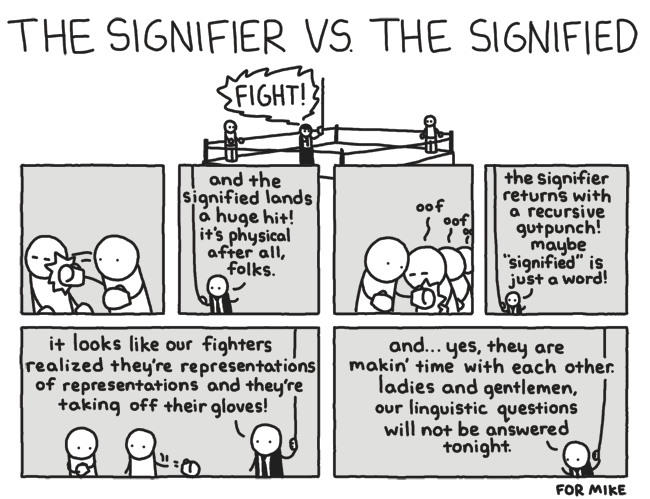
Admittedly, unlike the cartoon (taken from UPenn’s Language Log blog) this post is tepid stuff. I find myself, by inclination a descriptivist about propriety in language, vexed by the overuse of “goddess” and “planet” and even “club.”

Each of these words has been debased and lost some of its grandeur by their use in marketing.

This screed of mine began as I looked across the desk, delaying grading student work, when my eyes lighted on the box of biscotti I’d picked up at Ellwood Thompson’s Local Market, my favorite place to shop. The brand, Biscotti Goddess, appears at the local coffee shop and I’m fond of them.

I’m not fond of the name. Deities, even heathen ones, or especially those, merit some respect.  I’d say “Biscotti Diva” except I’d be falling into the same trap.

My concern with using such signifiers this way comes from the ability to suck the life from what they signify.  If you look up “weasel word” in Wikipedia, you’ll see that the term comes from how an actual weasel empties an egg that still appears intact.

And thus with language. Almost time for Planet Lunch!