Word of the Week! Dusking

Village lights on a cliff at duskThis time of year the sunsets get awfully nice, and the temperatures moderate enough to enjoy some outdoor time at dusk. I’ve covered gloaming here before, eight (!) years ago, but recently a new-to-me term cropped up in a BBC story. You can find a full description of the term here at a Conversation post.

That piece notes that dusking “involves watching the light start to disappear, noticing the changing colours of the sky, the emergence of evening sounds.” This serves as a form of relaxation. My wife do this nearly every night when the weather allows, from our screened-in back porch or open front porch. With a cool drink and my occasional cigar, it’s a perfect way to celebrate quietly the passing of the day.

This piece and the BBC story link the rise in dusking to the Netherlands. It makes sense; after a brutally hot summer in 2026, Northern Europeans probably sigh in relief, as Virginians have done for a long time, and head outside to see the last of the light. I am just old enough to recall life in Richmond before central air-conditioning or even, in our modest neighborhood south of what is now Carytown, window units. Every home on the block had sizable front porches, some with ceiling fans, where we gathered at dusk. People took short walks and said hello. There was an ice-cream parlor within a five-minute stroll. It was a delightful ritual of the mid-1960s soon to vanish onto back decks and family rooms with color TVs. At the time, however, it seemed as if dusking on the front porches would never end. I wish that world still existed.

Today at our house, without neighbors to greet, we pick the front or back porch and continue the tradition. We joke about the word “mauve” and pronounce it in various ways. You only see those colors emerge around dawn and dusk.

I label this use of “dusking” as a neologism, but the word itself dates to the 16th Century, as the OED notes.

Neologism or not, I want our modern sense of the word to become common. We live in a time of screen-blindness, cognitive offloading to imperfect AI models, wasteful haste, and a ridiculous “fear of missing out.”

Just don’t miss out on that next sunset. I would love to see dusking become our next addiction.

Send in words or metaphors worth covering. Email me (jessid -at- richmond -dot- edu) or leave a comment below. Want to write a guest entry? Let me know!

See all of our Metaphors of the Month here and Words of the Week here.

Image: Creative-commons license by Cathay Pacific.
Metaphor of the Month! Trojan Horse

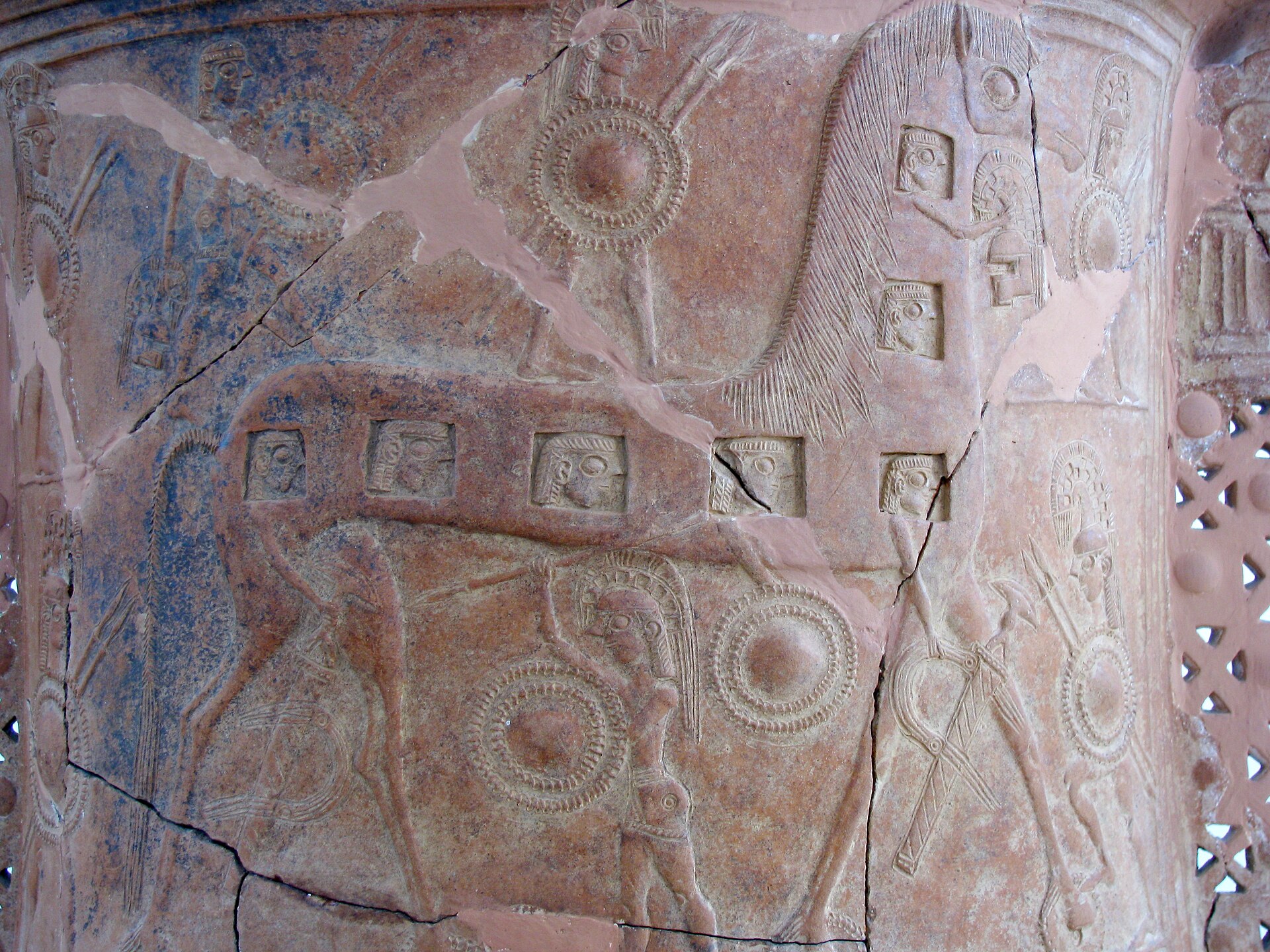
Mykonos Vase Trojan HorseHow timely, this post and Christopher Nolan’s epic The Odyssey. I don’t need to delve far into the etymology of this word, but its continued use  (like Achilles’ Heel, covered here earlier) attests to the power of the image as well as its source material.

For our horse, however, we also see how powerful trickery can be, especially when cloaked in the guise of a gift. Matt Damon’s Odysseus certainly captures the consequences of such deceit in the film.

I’d hazard a guess that the metaphor has been with us as long as Homer’s stories. Today many of us have fallen prey to the modern Trojan Horse: a piece of innocent-seeming software containing a virus or other “malware.” Usually, the attack comes from a reputable-looking sender or a family member whose contact lists have been hacked. These are, indeed, gift horses whose mouths we should look into.

You could call any “phishing” attempt that asks you to click a link or open a file attachment a Trojan Horse. I.T. folk often refer to them as “Trojans,” which has other inferences I won’t discuss, as this is a family-friendly blog.

Beware of Geeks (and ancient Greeks) bearing gifts.

“Beware of Greeks bearing gifts”: that saying comes from Virgil’s Aeneid, a far later epic of Roman origin, but it captures the idea of a Trojan Horse masterfully.

Send me words and metaphors worth covering, but not as suspicious file attachments or links! Email me (jessid -at- richmond -dot- edu) or leave a comment below. Want to write a guest entry? Let me know!

Image: Wikipedia, the Mykonos Vase, one of the earliest known depictions of the Trojan Horse, c. &50-650 BCE).

Word of the Week! Moribund

Late Summer pasture

With classes about to resume on campus, the moribund time of late summer is about to end. Caveat: it ends for the students and those faculty and staff working next semester; I’m away from teaching until perhaps Spring 2027 as I finish some scholarly writing. My retirement, such as it is, has not been moribund at all, even as I get to savor the Golden Hour in September from my back porch, not through a car’s windshield on a commute.

“Moribund” has a dreary sound, doesn’t it? The OED entry notes it means “at the point of death; in a dying state, close to death,” and that certainly describes our summer vacation now. At the same time, I thought that it also meant “stuck or stagnant,” and the entry online has a second definition of “displaying such a lack of vigour or vitality that recovery appears impossible.” Right on the money, again!

I wonder if the use of our word has become moribund? It was first recorded in the early 1700s; usage peaked in 1950 and has suffered a steady decline that appears irreversible. Funny thing, that: we are now about about the same usage frequency as the year 1900. The 20th century, so vital and dangerous in many ways, also served as the period of popularity for the word. I’ll hazard a guess that the reading public had better vocabularies then. Reading for pleasure, in these frantic times, seems moribund.

I like the term, because of its dreary, deathly sound but I doubt we’ll see it spring back to life as a popular word, in my lifetime.

Set aside your back-to-school plans for a moment to send in words or metaphors worth covering. Email me (jessid -at- richmond -dot- edu) or leave a comment below. Want to write a guest entry? Let me know!

See all of our Metaphors of the Month here and Words of the Week here.

Image: Late Summer by Christian Kortum at Flickr.

Word of the Week! Conundrum

Whirlpool in ScotlandNow that my password is reset at UR and I’ve the two-factor app on my new phone, these posts can resume. I feel, however, that all of our technology has put us into a conundrum: what was supposed to make life simpler has led to many complications. Consider all the passwords you have to set, all the pop-up windows you have to close, ads to block, spam to filter.

This was not the promise of the Internet in the 1990s. Instead, we are faced with an unsolvable riddle, a dilemma, a paradox. In short, a conundrum.

Our word’s etymology merits a look. The Online Etymology Dictionary has this fascinating history:

“1590s, an abusive term for a person, perhaps meaning ‘a pedant;’ c. 1600, ‘a whim;’ 1640s, ‘pun or word-play,’ a word of unknown origin, said in 17c. to be Oxford University slang.”

I have never heard anyone called a conundrum, though I’ve known plenty of pedants and been called one myself. But we can see from the evolution in our word’s meaning how the sense of something that eludes an easy answer came to be.

As for our technology conundrums? Go analog more. Silence the phone. Ditch the Social Media conundrum of it promising to connect us but instead dividing us.

Get an ad blocker. Good luck!

As Summer wanes (thank goodness; I hate hot weather) and Fall semester resumes, send in words or metaphors worth covering. Email me (jessid -at- richmond -dot- edu) or leave a comment below. Want to write a guest entry? Let me know!

See all of our Metaphors of the Month here and Words of the Week here.

Image: The Gulf of Corryvreckan whirlpool in Scotland, From Wikipedia.

Metaphor of the Month! Earworm

Boy with fingers stuck in ears

We have, this week, a first cousin the the term lyricosis, covered a few weeks ago.

The earworm provides a vivid metaphor when a piece of music gets lodged in your ear and you cannot stop hearing it.

As early as the 16th Century, as the OED attests, an earworm meant an earwig, a common insect that is easy imagine crawling into some sleeper’s ear. There it would lay eggs that hatch brain-eating larvae. To date, I’ve know exactly zero people who have had this horror occur to them. Wikipedia’s entry on the creature claims the idea to be no more than an Old Wives’ Tale, a term worth a future post as metaphor of the month.

On the other hand, I was surprised to find that 1982 marks The OED’s first recorded use of our metaphor in the sense we use it today. What did we call such brain lodgements of music before the Reagan Era?

From ten years earlier, there’s one song I love to hate, “Sylvia’s Mother,” a 1972 hit by the rock band Doctor Hook’s Medicine Show. A talented children’s cartoonist and author, Shel Silverstein, wrote this clunker. It bubbles up out of my subconscious every so often and I begin to sing it. My old man and I would belt it out, amid gales of laughter, along with the radio when it came on in the car; he despised the song as much as I do. Dad’s verdict was “That lady was a good mother. The guy on the phone sounds like a loser!” After singing the song, the demon would be exorcised for several months.

The only way for me to be rid of an Earworm, apparently, is to feed it once in a while!

If you have other solutions, please share them, along with words or metaphors worth covering. Email me (jessid -at- richmond -dot- edu) or leave a comment below. Want to write a guest entry? Let me know!

See all of our Metaphors of the Month here and Words of the Week here.

Creative-Commons Image: Chris Rowbury’s Blog

Word of the Week! Mogul

I strongly recommend that anyone in the area attend the exhibition “India’s Great Mughals: Art, Power, and Opulence” at the Virginia Museum of Fine Arts. It is yet another stunner from America’s finest state-run museum.

But this blog is not about museums; it’s about words. The wealth of the royal court of the Mughal empire seems distant now, unless one goes to the Taj Mahal or uses the word “mogul.” Dating from 1653 in the sense I wish to discuss, according to the OED, our term comes directly from the Anglicized version of “Mughal,” itself an Urdu word for “Mongol,” since the Mughals traced their ancestry back to Genghis Khan.

In our modern sense, this week’s word means a person of great wealth and power.

The OED’s most recent citation, from 1999, notes that Rupert Murdoch is “a television mogul.” We had movie moguls from the first half of the last century, then software moguls at the turn of the century, though (if I recall correctly) Neal Stephenson called them “software khans” in one of his science-fiction novels. I still prefer that term!

Today, amid the vast sums of money swirling around artificial intelligence, we have AI moguls. All of them, so far, are humans. At times I do wonder, but that would make another post.

The word’s frequency of use bottomed out in 2021 and then began a slow climb. We seem to be in a new era of moguls and their empires. Where it ends, no one knows. The Mughal Empire peaked and then experienced a series of bad leaders and overly lavish living, as its sphere of influence and power slowly withered.

Send me words and metaphors worth covering. Email me (jessid -at- richmond -dot- edu) or leave a comment below. Want to write a guest entry? Let me know!

See all of our Metaphors of the Month here and Words of the Week here.

Image: Shah Jahan and an gem. Who knew that he, like me, collected rocks? Image by me.

Word of the Week! Lyricosis

Creedence Clearwater RevivalWhile enjoying the July 4th holiday, outside if you can bear the heat wave, turn on some music. Then consider how you might mishear the lyrics to many a popular song.

“More than a woman,” a 70s hit, became “Bald-headed woman.” I can provide many more examples of lyricosis, or if you prefer Grammar Girl’s term, a Mondegreen, from a writer named Sylvia Wright who misheard a Scottish ballads’ words “and laid him on the green” as “And Lady Mondegreen.”

I have a feeling that lyricosis will outlive its rival, though the OED prefers Mondegreen, offering no entry for lyricosis, and dates Mondegreen’s first use to 1954. I disagree; “lyricosis” has the right root and affix to make it resemble a problem of the ears. “Mondegreen” is a bit too precious and obscure to catch on as slang when we are talking about Abba’s misheard lyric “Dancing Queen, young and sweet, only seven teeth.”

You youngsters might think lyricosis only afflicts those who listen to “Dad Rock” (as if The Ramones would ever qualify, after writing “Teenage Lobotomy“). I disagree: maybe the digital equipment plugged into your fully-functional ears does deliver crisper sound than radio or scratchy LPs, but if a singer slurs any words, you might suffer from lyricosis yourself. While I didn’t ask for AI help, it helped anyway during a Web search, noting that in Taylor Swift’s “Blank Space,” many hear “All the lonely Starbucks lovers” instead of “Got a long list of ex-lovers,” which seems a stretch but it is funny. That’s the point of lyricosis.

Our word is a neologism, much like musician Steve Miller’s term “Pompatus” that I covered here.

Remember, readers, at the cookout, don’t kiss a fly. `Happy Fourth of July.

Also don’t be afraid to send me misheard lyrics, or words and metaphors worth covering. Email me (jessid -at- richmond -dot- edu) or leave a comment below. Want to write a guest entry? Let me know!

See all of our Metaphors of the Month here and Words of the Week here.

Image source: Creative-Commons image of Creedence Clearwater Revival, looking for that bathroom on the right.

Word of the Week! Doohickey

Cat with computer parts

Editor’s Note: Reader Michael Stern authored this post for our summer enjoyment. Consider how many “doodad” or “doololly” or “doojolly” words relate to this neologism. Etymology Online does not give this origin but notes it to be an American neologism from 1914. Now on to Michael’s post.

Merriam-Webster’s Collegiate Dictionary defines doohickey as a “doodad,” which is itself defined as “an often small article whose common name is unknown or forgotten: gadget.” The OED defines it as “any small object, esp. mechanical; a ‘thingummy.” Neither offer a useful derivation but I happened upon what might be a reasonable and interesting one.

On July 9, 1776, Virginia patriots attacked Lord Dunmore and his supporters who were holed up on Gwynn’s Island in Chesapeake Bay. Embedded with the patriots was a French artillery captain who had joined the Continental Army. He built an experimental wooden mortar which was put to use in the attack, only to explode, killing him. He was the only casualty on the patriot side. His name was Dohicky Arundel.

Perhaps Arundel’s given name became a synonym for a nameless contraption (although more than a hundred years would pass before its first recorded use in Kansas Farmer in 1908, according to the OED.)

My source for this information is A Perfect Frenzy: A Royal Governor, His Black Allies, and the Crisis That Spurred the American Revolution by Andrew Lawler. My wife and I attended a lecture by Lawler at UR a few months ago and, needless to say, we purchased his book.

Send us words, thingamabobs, whatchamacallits, linguistic kluges, and metaphors worth covering. Email me (jessid -at- richmond -dot- edu) or leave a comment below. Want to write a guest entry? Let me know!

See all of our Metaphors of the Month here and Words of the Week here.

Creative-Commons Image: Sleepypete’s blog. Thanks, Pete. 

Word of the Week! Aeolian

Aeolian harp

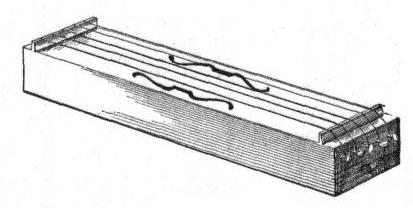
Even older than Achilles, the subject of my last entry, is the Greek god of wind, Aeolus.  From the god’s name we get our word, meaning an effect of the wind. In geology, it can mean wind-borne erosion. I’ve seen the word employed to describe features on the planet Mars, where NASA rovers are at work currently.

I first encountered the word, as “Eolian,” in an undergraduate class on the Romantic writers of England. Perhaps you know Samuel Taylor Coleridge’s 1795 poem “The Eolian Harp“? Take a peek. While it is not my favorite of his works, it certainly fixed the word we are discussing in my mind:

And that simplest Lute,
Placed length-ways in the clasping casement, hark!
How by the desultory breeze caressed,
Like some coy maid half yielding to her lover,
It pours such sweet upbraiding, as must needs
Tempt to repeat the wrong! 

At the time, many English were placing one of these wind-harps in an open window. The instrument is older still; Wikipedia’s entry on the harp cites a first description of it in the 1600s, but the instrument itself is ancient. You can find an interesting page on the harp’s history here. The OED notes that as a descriptor for a native of the Aeolian Islands, our word has a first recorded usage of 1546.

The passage of the wind would produce music quite different from a wind chime, though that too is an aeolian instrument (as compared to one that requires human breath to make music). In Coleridge’s era, there amounted to a bit of a craze for these devices, so romantics of all stripes could get one ready made.

Today it’s a bit harder to find one in Costco, so I recommend you build one. Kevin Busse offers some advice here for unusual designs that don’t require an open window. Other sites recommend building it to fit your casement. Here’s a favorite site, Fil Corbitt’s The Wind, with a page on various free-standing harps. Have a listen to the haunting melody from an “Obsidian Sky Wind Harp” (note: the harp has a high pitch, so turn down your volume at first!).

The blog will continue all summer, so send me words and metaphors worth covering. Email me (jessid -at- richmond -dot- edu) or leave a comment below. Want to write a guest entry? Let me know!

See all of our Metaphors of the Month here and Words of the Week here.

Creative-Commons image source: Wikipedia

Metaphor of the Month! Achilles Heel

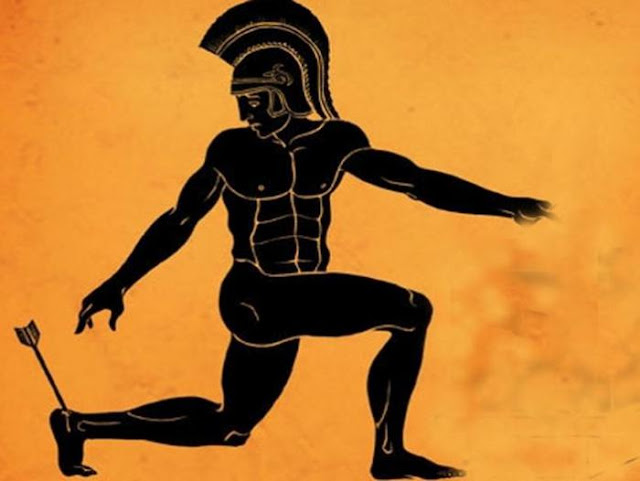
Achilles struck in heel by an arrow.This is a term I use frequently, probably too frequently. I’ve considered covering another metaphor here from Antiquity, Thucydides Trap, that has been in the news lately. Let’s save that for June.

What of an Achilles Heel?

Our ongoing war with Iran revealed an ugly truth about US life: if you want to make Americans angry across all the social and cultural divides, just raise gas prices. Despite our nation being a net exporter of oil, that commodity gets priced on a global market. If supplies get pinched anywhere, prices rise everywhere. Globally, then, oil prices are an Achilles Heel for our technological civilization. From stupid one-use plastic bags to high-test gas to the diesel in my farm tractors, petrol remains the key ingredient.

It’s then our weakest point. The OED dates the use of the metaphor back to 1705, but the story of nearly invincible Achilles stretches back to Homeric Greece and certainly beyond.  The son of a goddess, Achilles got a magical protection from his mother Thetis, who held the boy by his heel and dipped him into the River Styx in the underworld. His heel remained vulnerable, and there an arrow found him during the Trojan War.

Achilles, a cruel warrior, met his doom. Let’s hope we don’t follow him in our addiction to fossil fuels of all sorts. The usage chart at the OED shows no sign of tapering off. Our metaphor, sadly, remains a fresh one.

Update on “Muster”: I covered this term last time, and a reader on campus sent me an example from STEM: “From a psychological standpoint, imagine being a graduate student, particularly a new one, and you find some amazing new chemical entity that passes muster in all respects except for the fact that it is repeatedly returned as a “fail” from a company you do not know.”

Let’s not forget that “muster” appears often in the phrase “pass muster,” which may relate to how soldiers get inspected when they muster for roll call. As I learned in military school, shine that brass and polish those shoes!

The blog will continue all summer, so muster your courage and send me words and metaphors worth covering. Email me (jessid -at- richmond -dot- edu) or leave a comment below. Want to write a guest entry? Let me know!

See all of our Metaphors of the Month here and Words of the Week here.

Creative Commons Image: Achilles from gamificapassengers.blogspot.com