Metaphor of the Month! Trojan Horse

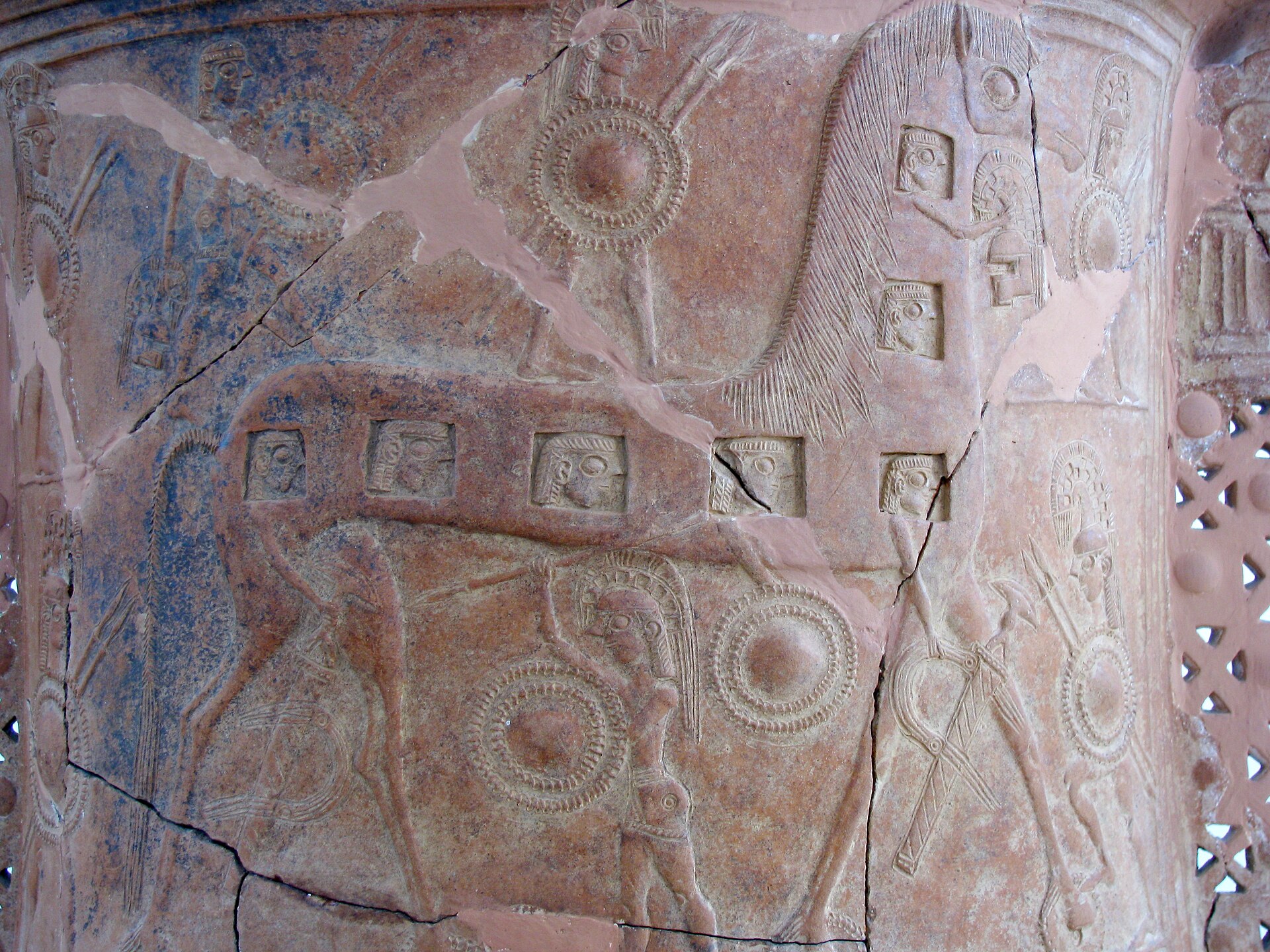
Mykonos Vase Trojan HorseHow timely, this post and Christopher Nolan’s epic The Odyssey. I don’t need to delve far into the etymology of this word, but its continued use  (like Achilles’ Heel, covered here earlier) attests to the power of the image as well as its source material.

For our horse, however, we also see how powerful trickery can be, especially when cloaked in the guise of a gift. Matt Damon’s Odysseus certainly captures the consequences of such deceit in the film.

I’d hazard a guess that the metaphor has been with us as long as Homer’s stories. Today many of us have fallen prey to the modern Trojan Horse: a piece of innocent-seeming software containing a virus or other “malware.” Usually, the attack comes from a reputable-looking sender or a family member whose contact lists have been hacked. These are, indeed, gift horses whose mouths we should look into.

You could call any “phishing” attempt that asks you to click a link or open a file attachment a Trojan Horse. I.T. folk often refer to them as “Trojans,” which has other inferences I won’t discuss, as this is a family-friendly blog.

Beware of Geeks (and ancient Greeks) bearing gifts.

“Beware of Greeks bearing gifts”: that saying comes from Virgil’s Aeneid, a far later epic of Roman origin, but it captures the idea of a Trojan Horse masterfully.

Send me words and metaphors worth covering, but not as suspicious file attachments or links! Email me (jessid -at- richmond -dot- edu) or leave a comment below. Want to write a guest entry? Let me know!

Image: Wikipedia, the Mykonos Vase, one of the earliest known depictions of the Trojan Horse, c. &50-650 BCE).

Word of the Week! Moribund

Late Summer pasture

With classes about to resume on campus, the moribund time of late summer is about to end. Caveat: it ends for the students and those faculty and staff working next semester; I’m away from teaching until perhaps Spring 2027 as I finish some scholarly writing. My retirement, such as it is, has not been moribund at all, even as I get to savor the Golden Hour in September from my back porch, not through a car’s windshield on a commute.

“Moribund” has a dreary sound, doesn’t it? The OED entry notes it means “at the point of death; in a dying state, close to death,” and that certainly describes our summer vacation now. At the same time, I thought that it also meant “stuck or stagnant,” and the entry online has a second definition of “displaying such a lack of vigour or vitality that recovery appears impossible.” Right on the money, again!

I wonder if the use of our word has become moribund? It was first recorded in the early 1700s; usage peaked in 1950 and has suffered a steady decline that appears irreversible. Funny thing, that: we are now about about the same usage frequency as the year 1900. The 20th century, so vital and dangerous in many ways, also served as the period of popularity for the word. I’ll hazard a guess that the reading public had better vocabularies then. Reading for pleasure, in these frantic times, seems moribund.

I like the term, because of its dreary, deathly sound but I doubt we’ll see it spring back to life as a popular word, in my lifetime.

Set aside your back-to-school plans for a moment to send in words or metaphors worth covering. Email me (jessid -at- richmond -dot- edu) or leave a comment below. Want to write a guest entry? Let me know!

See all of our Metaphors of the Month here and Words of the Week here.

Image: Late Summer by Christian Kortum at Flickr.

Word of the Week! Conundrum

Whirlpool in ScotlandNow that my password is reset at UR and I’ve the two-factor app on my new phone, these posts can resume. I feel, however, that all of our technology has put us into a conundrum: what was supposed to make life simpler has led to many complications. Consider all the passwords you have to set, all the pop-up windows you have to close, ads to block, spam to filter.

This was not the promise of the Internet in the 1990s. Instead, we are faced with an unsolvable riddle, a dilemma, a paradox. In short, a conundrum.

Our word’s etymology merits a look. The Online Etymology Dictionary has this fascinating history:

“1590s, an abusive term for a person, perhaps meaning ‘a pedant;’ c. 1600, ‘a whim;’ 1640s, ‘pun or word-play,’ a word of unknown origin, said in 17c. to be Oxford University slang.”

I have never heard anyone called a conundrum, though I’ve known plenty of pedants and been called one myself. But we can see from the evolution in our word’s meaning how the sense of something that eludes an easy answer came to be.

As for our technology conundrums? Go analog more. Silence the phone. Ditch the Social Media conundrum of it promising to connect us but instead dividing us.

Get an ad blocker. Good luck!

As Summer wanes (thank goodness; I hate hot weather) and Fall semester resumes, send in words or metaphors worth covering. Email me (jessid -at- richmond -dot- edu) or leave a comment below. Want to write a guest entry? Let me know!

See all of our Metaphors of the Month here and Words of the Week here.

Image: The Gulf of Corryvreckan whirlpool in Scotland, From Wikipedia.

Metaphor of the Month! Liminal Space

Original room that inspired "The Backrooms" series.

Where oh where have 7 years gone? It was yesterday, it seems, that I covered the word “liminal” in this blog. It’s a fancy word for a transition, really. Academics love it in the Humanities, but lately it has taken on a new life with a different category of geeks, namely gamers and internet-forum junkies when used to describe certain sorts of disturbing spaces.

You may have seen advertisements for the horror film The Backrooms. The image above comes from an Internet meme at 4chan that began the uptick in usage for our metaphor. It was taken at a closed furniture store in Oshkosh, Wisconsin. It’s now a Hobby Town franchise. How the various Backrooms fanatics found that out, I don’t know, but if you wish to dive into the history of this meme, here you go.

I’ve seen Web series called The Backrooms by Kane Parsons; it’s excellent.  I find the episodes the sort of psychological horror for those who dislike blood and gore (that would include me). It’s really a masterpiece of the uncanny. I hope the new feature film by Parsons captures that mood as well.

What I find outstanding about The Backrooms concept is how it plays into a uneasiness we all experience when traversing empty transitional spaces. I’ve heard college classrooms called liminal spaces; we don’t decorate them as do K-12 teachers. They are generic and when vacant, mildly unsettling. So are parking garages, empty subway cars, hotel corridors, and even lonely highways (for many of us; I love traveling empty backroads, at least in daylight).

Empty hotel corridorThis corridor looks familiar, but it would have a eerie effect on many of us who travel it, even if we had not seen Kubrick’s The Shining. Where are the other guests? Not all liminal spaces are confining. I’d claim that a busy airport terminal feels very different from one late at night, when the last flights have landed and the snack bars have closed. You know what I mean if you have arrived in the wee hours because of a delay.

My pop-psych explanation for The Backrooms craze? COVID-19. We were suddenly confronted with empty spaces that had once teemed with people. I flew through Chicago just a few weeks before the outbreak. It now seems like another world, even compared to airports I visit now. Then for a while, airports all looked like this.

Empty Airport Terminal

There’s a danger of the metaphor: once you start noticing liminal spaces you cannot stop. The other day I was on campus and visited the Humanities Building, where I once had my office. No one was about, and my footsteps echoed in the corridors. I didn’t tarry long there and got quickly into the bright sunlight.

It unsettled me in a familiar way. One summer, I had the unenviable job of working until midnight at Indiana University’s windowless graduate stacks. I’d start at the 12th floor, sing out that the library was closing, and then turn out the lights. We had to do this for safety reasons. Grad students would work late and fall asleep at their study carrels.

This chore was not frightening, with a master switch for the lights by the stairs, except on one floor. There I had to walk all the way to the end of the stacks to get to the switch. I’d then race back to the stairwell, with only an emergency light to guide me and a feeling that someone, or something, was watching me every night. Every library worker I knew shared the same fear. We waited for that hand to dart out from between the shelves and grab us.

Library Stacks Empty

For this and many other reasons, the psychology of liminal spaces interests me, and you can make a beginning study of it all here. Finally, if you see The Backroooms, let me know what you think.

Perhaps I should have saved this post for Halloween! Pleasant dreams.

Don’t be afraid to send me words and metaphors worth covering. Email me (jessid -at- richmond -dot- edu) or leave a comment below. Want to write a guest entry? Let me know!

See all of our Metaphors of the Month here and Words of the Week here.

Creative-Commons images From Wikipedia; Singapore airport image by David Gan. IU Library Stacks from Pinterest.
Word of the Week! Aeolian

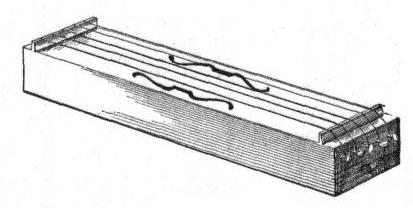
Aeolian harp

Even older than Achilles, the subject of my last entry, is the Greek god of wind, Aeolus.  From the god’s name we get our word, meaning an effect of the wind. In geology, it can mean wind-borne erosion. I’ve seen the word employed to describe features on the planet Mars, where NASA rovers are at work currently.

I first encountered the word, as “Eolian,” in an undergraduate class on the Romantic writers of England. Perhaps you know Samuel Taylor Coleridge’s 1795 poem “The Eolian Harp“? Take a peek. While it is not my favorite of his works, it certainly fixed the word we are discussing in my mind:

And that simplest Lute,
Placed length-ways in the clasping casement, hark!
How by the desultory breeze caressed,
Like some coy maid half yielding to her lover,
It pours such sweet upbraiding, as must needs
Tempt to repeat the wrong! 

At the time, many English were placing one of these wind-harps in an open window. The instrument is older still; Wikipedia’s entry on the harp cites a first description of it in the 1600s, but the instrument itself is ancient. You can find an interesting page on the harp’s history here. The OED notes that as a descriptor for a native of the Aeolian Islands, our word has a first recorded usage of 1546.

The passage of the wind would produce music quite different from a wind chime, though that too is an aeolian instrument (as compared to one that requires human breath to make music). In Coleridge’s era, there amounted to a bit of a craze for these devices, so romantics of all stripes could get one ready made.

Today it’s a bit harder to find one in Costco, so I recommend you build one. Kevin Busse offers some advice here for unusual designs that don’t require an open window. Other sites recommend building it to fit your casement. Here’s a favorite site, Fil Corbitt’s The Wind, with a page on various free-standing harps. Have a listen to the haunting melody from an “Obsidian Sky Wind Harp” (note: the harp has a high pitch, so turn down your volume at first!).

The blog will continue all summer, so send me words and metaphors worth covering. Email me (jessid -at- richmond -dot- edu) or leave a comment below. Want to write a guest entry? Let me know!

See all of our Metaphors of the Month here and Words of the Week here.

Creative-Commons image source: Wikipedia

Metaphor of the Month! Achilles Heel

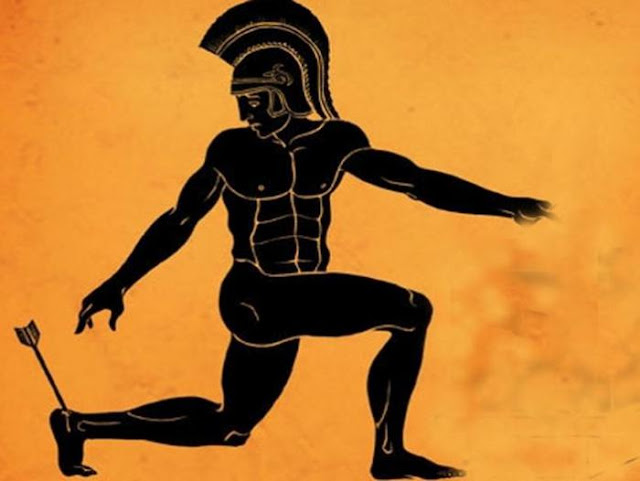
Achilles struck in heel by an arrow.This is a term I use frequently, probably too frequently. I’ve considered covering another metaphor here from Antiquity, Thucydides Trap, that has been in the news lately. Let’s save that for June.

What of an Achilles Heel?

Our ongoing war with Iran revealed an ugly truth about US life: if you want to make Americans angry across all the social and cultural divides, just raise gas prices. Despite our nation being a net exporter of oil, that commodity gets priced on a global market. If supplies get pinched anywhere, prices rise everywhere. Globally, then, oil prices are an Achilles Heel for our technological civilization. From stupid one-use plastic bags to high-test gas to the diesel in my farm tractors, petrol remains the key ingredient.

It’s then our weakest point. The OED dates the use of the metaphor back to 1705, but the story of nearly invincible Achilles stretches back to Homeric Greece and certainly beyond.  The son of a goddess, Achilles got a magical protection from his mother Thetis, who held the boy by his heel and dipped him into the River Styx in the underworld. His heel remained vulnerable, and there an arrow found him during the Trojan War.

Achilles, a cruel warrior, met his doom. Let’s hope we don’t follow him in our addiction to fossil fuels of all sorts. The usage chart at the OED shows no sign of tapering off. Our metaphor, sadly, remains a fresh one.

Update on “Muster”: I covered this term last time, and a reader on campus sent me an example from STEM: “From a psychological standpoint, imagine being a graduate student, particularly a new one, and you find some amazing new chemical entity that passes muster in all respects except for the fact that it is repeatedly returned as a “fail” from a company you do not know.”

Let’s not forget that “muster” appears often in the phrase “pass muster,” which may relate to how soldiers get inspected when they muster for roll call. As I learned in military school, shine that brass and polish those shoes!

The blog will continue all summer, so muster your courage and send me words and metaphors worth covering. Email me (jessid -at- richmond -dot- edu) or leave a comment below. Want to write a guest entry? Let me know!

See all of our Metaphors of the Month here and Words of the Week here.

Creative Commons Image: Achilles from gamificapassengers.blogspot.com

Word of the Week! Sine Qua Non

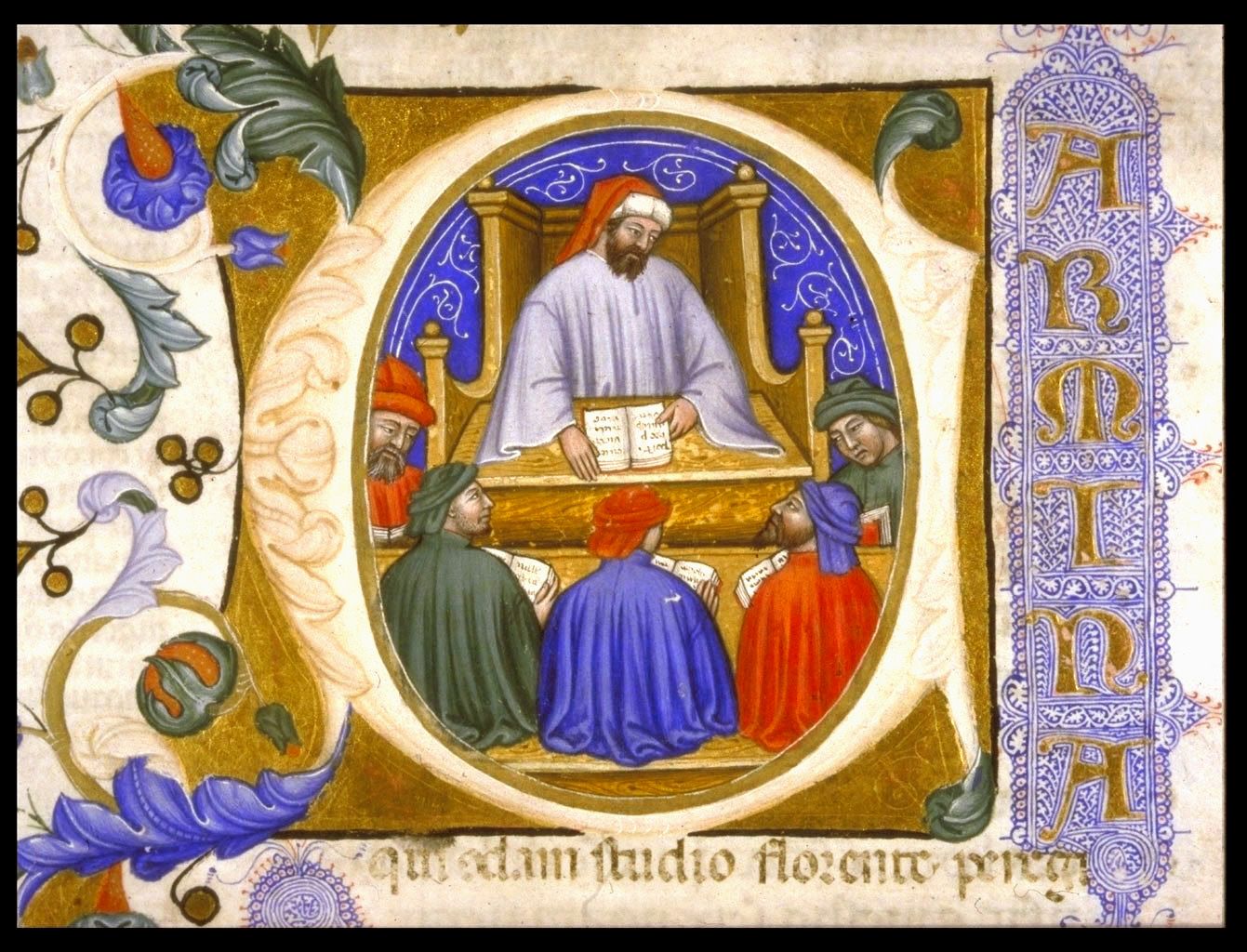
BoethiusThree words this week, for the price of one. I find this term useful; though I don’t use it myself, I have seen it recently in long-form journalism. Wikipedia has an entire entry on it, so here are a few highlights. See that Wikipedia entry for its application in writing about medicine and the law.

Let’s get the definition out of the way: a mandatory precondition, an essential element, a key ingredient. The full Latin term is condicio sine qua non. So “today, a valid passport is a sine qua non of international travel,” or “to govern well at any level today, knowledge of macroeconomics appears to be a sine qua non for successful leadership.”

The origin is ancient, as we can tell from its Latin roots. That meaning, as given in Wikipedia “without which [there is] nothing,” appeared in the work of the early Christian philosopher Boethius. Earlier still, Aristotle used its Greek equivalent. For formal writing, I always like how a Latin phrase or Latinate word elevates the occasion, as does my taste for dress shirts and sometimes a tie when in the classroom.

What are some other expressions where our phrase might impress readers and make your prose more formal?  We simply lack good alternatives in English. “Must have” sounds blunt to me.

Summer break is a sine qua non for most academics and their students. So are frequent posts in a successful blog. As Spring turns to Summer and students leave for break, I’ll still be posting here. Send metaphors and words to cover by e-mailing me (jessid -at- richmond -dot- edu) or leaving a comment below. Want to write a guest entry? Let me know!

See all of our Metaphors of the Month here and Words of the Week here.

Image of Boethius from Wikipedia.

Word of the Week! Nuance

Everglades sunsetWhen checking to see if I’d featured this useful term before, I found  FOUR pages of entries that contained “nuance” in the text but none that gave it a starring role. Time to fix that! Clearly, I love this word.

Frankly, I love anything nuances. You may know my hatred of the Superhero genre of film: I can tell you the plot after 10 minutes for most of them. Boring! They contain some clever dialogue but little mystery or surprise: those are the soul of nuanced stories.

So few things in our world–whatever zealots of any stripe say–are binary. Instead, we encounter subtle shades of differences, slightly varying experiences, a spectrum of personalities, not a series of pigeon-holes. Just put down the phone some twilight and watch a sunset unfold. No two are identical.

The Online Etymology Dictionary notes the origin of our word, “slight or delicate degree of difference in expression, feeling, opinion, etc.,” 1781, from French nuance “slight difference, shade of color.”

And there we have it. Now get out of your chair and enjoy some nuanced experiences outdoors as Spring unfolds. They are as close on the UR campus as a stroll around Westhampton Lake as the leaves unfurl.

Send words and metaphors my way by e-mailing me (jessid -at- richmond -dot- edu) or leaving a comment below. Want to write a guest entry? Let me know!

See all of our Metaphors of the Month here and Words of the Week here.

Image: Publicdomainpictures.net, “Everglades Sunset”

Word of the Week! Charlatan

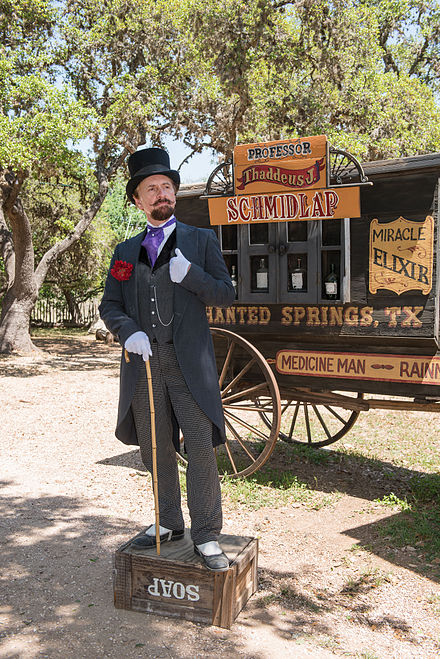
Snake Oil SalesmanOur trivia team, “Electric Mayhem,” got stumped by this word this week, so I decided I’d cover it.

Our trivia-host stated that he wanted a term that came from the Italian word “to babble” for a type of confidence man. We wrote down this week’s word, but we figured that the origin of our word was French, so we erased it. We’d have still lost that round, and so it goes.

Like “Montebank” that I’ve covered here before, this week’s work is of Italian parentage yet it shares French roots as well. I’ll use the same image. Whereas Montebank comes from the monta in banco, “to stand on a bench” TO sell that snake-oil, “Charlatan” has a more complex etymology. From The Etymology Dictionary Online:

“one who pretends to knowledge, skill, importance, etc.,” 1610s, from French charlatan “mountebank, babbler” (16c.), from Italian ciarlatano “a quack,” from ciarlare “to prate, babble,” from ciarla “chat, prattle,” which is perhaps imitative of ducks’ quacking.

Today we have charlatans online, promising us miracles. We have others in positions of great power. We have many who blog. I hope this post, at least, might babble a bit but present you with an accurate origin on a still-popular word.

Send words and metaphors my way by e-mailing me (jessid -at- richmond -dot- edu) or leaving a comment below. Want to write a guest entry? Let me know!

See all of our Metaphors of the Month here and Words of the Week here.

Image of “Professor Thaddeus Schmidlap, resident snake-oil salesman at the Enchanted Springs Ranch and Old West theme park” courtesy of Wikipedia, via the Library of Congress.

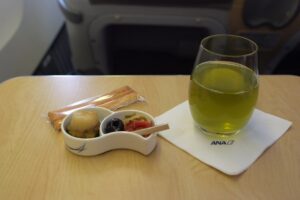
Word of the Week! Aperitif

in flight snack and drink

Reader Michael Stern, who describes himself as “a card-carrying student in the School of Professional and Continuing Studies” and a lifelong learner, nominated this week’s word. He’d seen it used in a novel way in a university announcement and asked if it might make a good word to discuss. I agree!

Our word is modern, with the first recorded borrowing from French in the 1890s. Michael’s sense of the term is correct: an aperitif is an alcoholic drink taken before dinner to stimulate appetite.

Though it’s not a traditional aperitif, a gin Martini is part of nearly every pre-dinner ritual for me. More than one drink like that makes me useless to the world, so “one and done” as we prepare food (I love to cook). Often we imbibe our drink with a small appetizer, which serves a very different purpose from an aperitif.

The appetizer takes the edge off one’s hunger, whereas the aperitif helps provoke appetite. You’ll find a list of traditional aperitifs here, including a vermouth I often use in my very traditional Martinis. Recipe follows:

  • 1/3 Vermouth,
  • 2/3 gin,
  • dash of bitters,
  • shaken with very small ice cubes; shaker and glasses and all ingredients cold,
  • Twist of lemon in warm weather, olive–never olive juice!–in winter).

According to the site noted in the last paragraph, “let the flavors of Noilly Prat Extra Dry Vermouth transport you to a world of sophistication.” This captures my sense of an aperitif; it’s for sipping sociably, not guzzling, chugging, shooting, etc. That’s juvenile drinking and a nasty habit to be left behind after college.

Back to our word: if something whets your taste for more, it can be, metaphorically, an aperitif. If it numbs that taste, it’s not.

Drink and eat responsibly this winter!

The blog will continue during exam week, with a final metaphor for 2025, then go on hiatus until the new year.

Send words and metaphors my way by e-mailing me (jessid -at- richmond -dot- edu) or leaving a comment below. Want to write a guest entry? Let me know!

See all of our Metaphors of the Month here and Words of the Week here.

Image: Appetizer and aperitif,”ANA SFO to NRT Business Class Inflight Meal” by Jun Seita, Flikr