Word of the Week! Aeolian

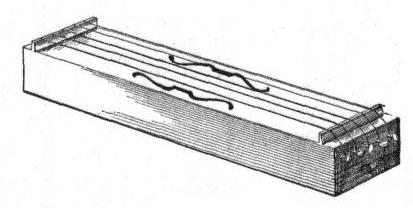
Aeolian harp

Even older than Achilles, the subject of my last entry, is the Greek god of wind, Aeolus.  From the god’s name we get our word, meaning an effect of the wind. In geology, it can mean wind-borne erosion. I’ve seen the word employed to describe features on the planet Mars, where NASA rovers are at work currently.

I first encountered the word, as “Eolian,” in an undergraduate class on the Romantic writers of England. Perhaps you know Samuel Taylor Coleridge’s 1795 poem “The Eolian Harp“? Take a peek. While it is not my favorite of his works, it certainly fixed the word we are discussing in my mind:

And that simplest Lute,
Placed length-ways in the clasping casement, hark!
How by the desultory breeze caressed,
Like some coy maid half yielding to her lover,
It pours such sweet upbraiding, as must needs
Tempt to repeat the wrong! 

At the time, many English were placing one of these wind-harps in an open window. The instrument is older still; Wikipedia’s entry on the harp cites a first description of it in the 1600s, but the instrument itself is ancient. You can find an interesting page on the harp’s history here. The OED notes that as a descriptor for a native of the Aeolian Islands, our word has a first recorded usage of 1546.

The passage of the wind would produce music quite different from a wind chime, though that too is an aeolian instrument (as compared to one that requires human breath to make music). In Coleridge’s era, there amounted to a bit of a craze for these devices, so romantics of all stripes could get one ready made.

Today it’s a bit harder to find one in Costco, so I recommend you build one. Kevin Busse offers some advice here for unusual designs that don’t require an open window. Other sites recommend building it to fit your casement. Here’s a favorite site, Fil Corbitt’s The Wind, with a page on various free-standing harps. Have a listen to the haunting melody from an “Obsidian Sky Wind Harp” (note: the harp has a high pitch, so turn down your volume at first!).

The blog will continue all summer, so send me words and metaphors worth covering. Email me (jessid -at- richmond -dot- edu) or leave a comment below. Want to write a guest entry? Let me know!

See all of our Metaphors of the Month here and Words of the Week here.

Creative-Commons image source: Wikipedia
Metaphor of the Month! Achilles Heel

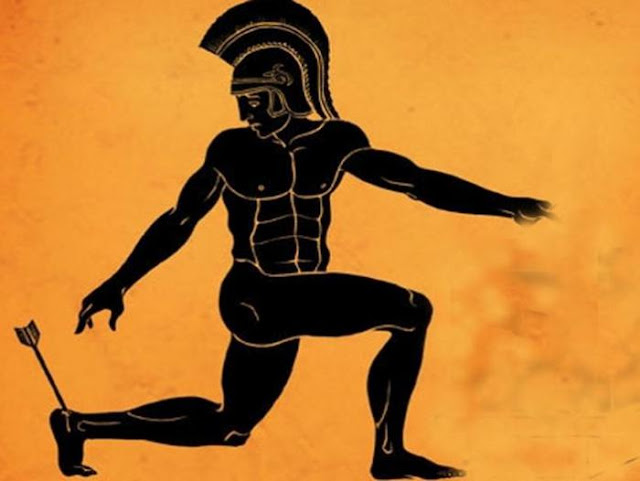
Achilles struck in heel by an arrow.This is a term I use frequently, probably too frequently. I’ve considered covering another metaphor here from Antiquity, Thucydides Trap, that has been in the news lately. Let’s save that for June.

What of an Achilles Heel?

Our ongoing war with Iran revealed an ugly truth about US life: if you want to make Americans angry across all the social and cultural divides, just raise gas prices. Despite our nation being a net exporter of oil, that commodity gets priced on a global market. If supplies get pinched anywhere, prices rise everywhere. Globally, then, oil prices are an Achilles Heel for our technological civilization. From stupid one-use plastic bags to high-test gas to the diesel in my farm tractors, petrol remains the key ingredient.

It’s then our weakest point. The OED dates the use of the metaphor back to 1705, but the story of nearly invincible Achilles stretches back to Homeric Greece and certainly beyond.  The son of a goddess, Achilles got a magical protection from his mother Thetis, who held the boy by his heel and dipped him into the River Styx in the underworld. His heel remained vulnerable, and there an arrow found him during the Trojan War.

Achilles, a cruel warrior, met his doom. Let’s hope we don’t follow him in our addiction to fossil fuels of all sorts. The usage chart at the OED shows no sign of tapering off. Our metaphor, sadly, remains a fresh one.

Update on “Muster”: I covered this term last time, and a reader on campus sent me an example from STEM: “From a psychological standpoint, imagine being a graduate student, particularly a new one, and you find some amazing new chemical entity that passes muster in all respects except for the fact that it is repeatedly returned as a “fail” from a company you do not know.”

Let’s not forget that “muster” appears often in the phrase “pass muster,” which may relate to how soldiers get inspected when they muster for roll call. As I learned in military school, shine that brass and polish those shoes!

The blog will continue all summer, so muster your courage and send me words and metaphors worth covering. Email me (jessid -at- richmond -dot- edu) or leave a comment below. Want to write a guest entry? Let me know!

See all of our Metaphors of the Month here and Words of the Week here.

Creative Commons Image: Achilles from gamificapassengers.blogspot.com

Word of the Week! Bowdlerize

Mick Jagger
Screenshot

I came across our word in an essay about the life and work of Wilfred Thesiger, whose book The Marsh Arabs I’m now reading. I knew it means a corruption of another’s writing, but I’d forgotten the etymology. It’s not a word I use frequently, so I needed a refresher.

One nice thing about our word involves its straightforward etymology as a neologism, though one from the early 19th Century. Here’s the complete entry from Merriam Webster Online:

In 1807, a new edition of the works of William Shakespeare hit the scene in England. Titled The Family Shakespeare, the collection of 20 of the Bard’s plays in four volumes was at first anonymously edited, and promised in its preface to “remove every thing that could give just offence to the religious or virtuous mind.” Though the sanitized project later became a public sensation (and a source of literary derision) after its expanded, ten-volume second edition was published in 1818 and credited solely to physician Thomas Bowdler, the original expurgation was in fact the work of his older sister Henrietta Maria “Harriet” Bowdler, an accomplished editor and author. Within a year of the younger Bowdler’s death in 1825, bowdlerize had come to refer to cutting out the dirty bits of other books and texts—testimony not only to the impact of his eye for impropriety, but to those of his sister Harriet as well, though her efforts were obscured by history, if not technically bowdlerized.

How many other less famous works have been “cleaned up” by survivors or literary executors? It’s a form of posthumous censorship, generally, though I think of a pop-culture example where the creators were very much alive. When the Rolling Stones appeared on Ed Sullivan’s variety show in 1967, they had to change the lyric “let’s spend the night together” to “let’s spend some time together” and if you can stomach the stupid commercials at YouTube, you can still enjoy Mick Jagger’s eye-rolling when he sings “time.”

Bowdler lives. Damn it. There, I cursed, using the very word that proved so infamous when Clark Gable uttered it in 1939, for Gone With the Wind. At Wikipedia, you can read about the controversy. It took a revision of the Production Board’s code to permit two banned words, “hell,” and “damn” into films.

Today we’ve thankfully moved far from those times, though have we gone too far? Students drop profanities like Autumn leaves as they walk across campus and, for that matter, we have a Presidential Administration full of people who curse like drunken sailors.

I love creative cursing, but I’m trying to bowdlerize my speaking habits. It’s *&%ing hard to do! This Thanksgiving, let’s be thankful for every curse we avoided in 2025 and keep that good habit going.

Wait. I have a solution. Let’s all curse like Yosemite Sam, nemesis of Bugs Bunny. Endure the commercials again to hear what I mean. No bowdlerizing needed.

Incidentally, you need not spell our word with a capital B.

Send any razza-flappin’, flip-floppin’, flig-flippin’ words and metaphors my way by e-mailing me (jessid -at- richmond -dot- edu) or leaving a comment below.

Consarn it!

Want to write a guest entry? Let me know!

See all of our Metaphors of the Month here and Words of the Week here.

Image: Jagger, mid-eye-roll screen cap from YouTube.

Word of the Week! Picayune

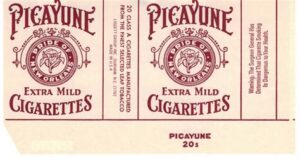
Cigarette paper wrapperI love this word. I love the idea that New Orleans named a newspaper after it. There’s a Mississippi town called Picayune that I should visit, and of course I love it that Mark Twain / Sam Clemens used the word and has also been skewered with it. In this recent example in The Atlantic by Graeme Wood, he describes a new biography focusing on Clemens’ difficult personal life and financial disasters thus: “His credulity led to misadventures the details of which are so picayune that Chernow’s emphasis on them can be maddening.” No detail about Clemens’ life can be maddening to me: I immediately ordered a copy of Chernow’s giant biography, Mark Twain.


What makes something picayune? We have an answer! The OED notes a French / Occitan etymology but Southern US origin with an 1806 first recorded use, “One can’t buy anything [at New Orleans] for less than a six cent piece, called a picayune.” Over time, the term morphed from a small amount of money to a trifling amount to a worthless person. Thus it became a metaphor for things or people of no value.

We can name many such persons, some with considerable influence (I don’t care for influences nor do I wish to be one). In any case, despite the rise of many picayune people and pastimes, our word continues a gradual decline in usage.

Send words and metaphors my way by e-mailing me (jessid -at- richmond -dot- edu) or leaving a comment below.

See all of our Metaphors of the Month here and Words of the Week here.

Image: though blocked by the picayune I.T. rules on campus, I managed to outsmart them and got this form cigarettecollector.net. I dislike cigs, but not cigars. They will yank my final stogie from my tobacco-stained, dead lips.


Word of the Week! Despondent

Man in suit, face buried in hand

It’s okay in these troubled times to feel despondent, as long as. you understand what the word means. I used it the other day in a light-hearted way, when touring Colonial Williamsburg. At the Governor’s Palace, two cooks were preparing a Colonial-era meal. The food smelled wonderful, and I said I’d like some. “Sorry, Sir,” came the reply. “It’s for the Governor’s table.”

I told the woman that I, a mere commoner, felt despondent.

“Nice choice of word!” she answered, without feeding me. I informed her that at least we had filled my belly with a word for this week.

For once, The OED entry on our word proves very brief, giving good definitions related to “loss of heart or resolution,” or simply being depressed. I find it depressing that the entry provides no examples of usage newer than 1849. How could such a useful word fall out of favor? Do we simply say “depressed” nowadays?

The word is of Latin origin, from dēspondēntem, with frequency of use falling markedly until about 1980, when despondent enjoyed (if that’s the term for it) an uptick in use. The Gay 1890s proved a paradoxically high-water mark, and now we are back about to 1960 in use of our word.

We need synonyms for unpleasant things. Saying “I’m down” or “I’m bummed out” do not work in formal prose. So cheer up! Even if I didn’t make you feel better, at least I’ve given you an new word for feeling bad.

Send me words and metaphors, uplifting or depressing, at jessid-at-richmond-edu or by leaving a comment below.

See all of our Metaphors of the Month here and Words of the Week here.

Image: Man probably looking at S&P 500 since January. Creative-Commons image from freestockphotos.biz

Word of the Week! Supine

Fainting CouchHard to think that this word, another I found in the work of Edith Wharton, has not yet appeared as a Word of The Week. So what do we know about “supine”?

The OED notes its Latin origin, to lie face upwards. The dictionary records earliest uses to the 15th Century, making it again a Gutenberg word. Printing simply made available a term already in the vocabulary of educated folk.

I thought of being supine as merely lying down, or for one of Wharton’s characters, collapsing upon a fainting couch.

To be truly supine, however, not just any sort of fainting will do. One must face upward, as in the final pose of Yoga practice, savasana or “corpse pose.”

Figuratively, as the OED entry also notes, our word can mean disinclined to act, from laziness, fear, greed, or some other motive. Here I’ve heard our word used to describe the current Congress, supine before a leader with authoritarian intentions.

When will they wake up? I thought that I had covered “Quisling” here before; perhaps that one will be a Metaphor of the Month soon. We shall see if events warrant that frightening word.

Send me words and metaphors at jessid-at-richmond-edu or by leaving a comment below.

See all of our Metaphors of the Month here and Words of the Week here.

Metaphor of the Month! Mother Nature

Mother nature advertisement for Chiffon MargarineYou may be old enough to recall a Chiffon Margarine advertising campaign featuring a woman dressed like an Earth-deity and the motto “It’s not nice to fool Mother Nature.”

I agree, though margarine never fooled me. I love cooking so bring on the butter, lard (for pie crusts), avocado oil, and olive oil. Otherwise, get out of my kitchen.

So where did the phrase Mother Nature come from? When was it first coined? The OED is wonky today, giving lots of page errors, but I detect two entries, with one giving a first recorded use of 1390. That means three years before the birth of Gutenberg, so it merits some attention. The problem with this usage, from Chaucer’s Physician’s Tale, comes from the lack of “Mother.” The teller does relate nature to a female deity, but that association goes back to a time not simply before printing but before writing itself.

The same entry gives a date of 1500 for “Dame Nature,” so we clearly see a pattern emerging. Not until 1962 does the OED replace “Dame,” perhaps from midcentury US usage as a belittling term for women, with “Mother.”

The second entry in the OED helps a great deal with our etymology, with instances of “mother nature,” without capital letters, reaching back to 1525.

As for Chiffon? The current owner of the brand discontinued US and Canadian distribution back in 2002, as Wikipedia informs me. Mother Nature had the last laugh. While I don’t think we have an actual angry goddess lashing out at puny homo sapiens who do so much harm to our ecosystems, pause a moment to pay some respect. With a real winter this year (which I love) it could seem that Mama ain’t happy with us. Or is it Papa? Old Man Winter is another metaphor worth our while (and for next year).

Meanwhile sit back, slow down, stay home if you can, enjoy the quiet ferocity of a snow-storm. It’s not nice to fool around with Old Man Winter, either.

If you think of any words or metaphors to share with the community in 2025, send them to me at jessid -at- richmond -dot- edu or by leaving a comment below.

That call for content includes updates and corrections. Regular reader Michael Stern gives us some clarity on our recent word of the week, inure:

“I have been a practicing attorney for more than fifty years and I have never seen the word inure spelled ‘enure.’  If I ever did, I probably would have thought it to be a spelling error.”

Excellent feedback. I always welcome it!

See all of our Metaphors of the Month here and Words of the Week here.

Word of the Week! Querulous

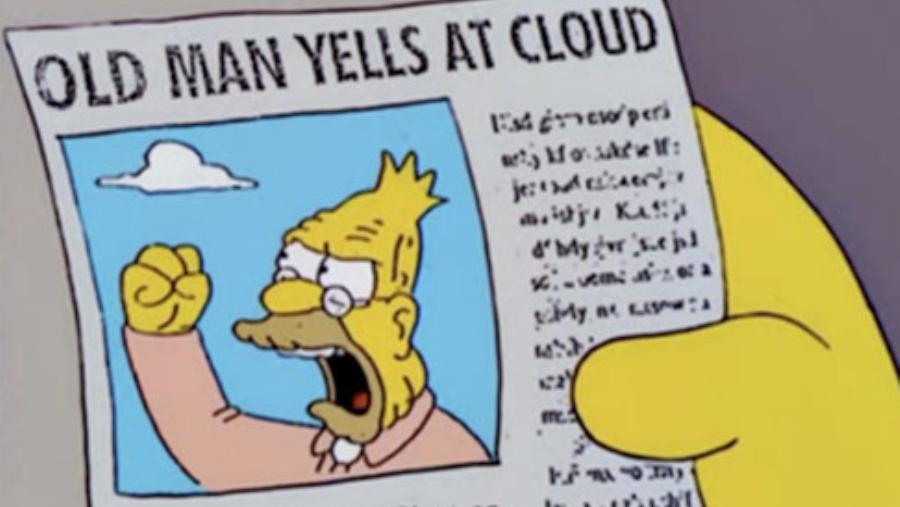
Old Man yells at Cloud: the SimpsonsHello, 2025.

My first retirement-era word relates, in my brain, to old age. It means to complain in a high-pitched voice. Sounds like a great deal of the Internet, doesn’t it?

I’m not here to complain. I’d like, first, to thank all of you readers who came by for my retirement reception. It humbled me to meet so many of you. Who the heck reads blogs these days?

Some of you. So thank you. I am not fully retired, however; I will be teaching a graduate course, “Writing With and About AI” for our School of Continuing Studies. AI will undoubtedly give us many new words and metaphors, but let’s stick to the Simpsons’ character yelling at a cloud. How did the word get associated with one’s “golden years”?

Etymology Online notes connections we might guess, to words such as “quarrel” with some rather old roots, “from Old French querelos ‘quarrelsome, argumentative’ and directly from Late Latin querulosus, from Latin querulus ‘full of complaints, complaining,’ from queri ‘to complain.’ ”

My notes about the word say “NB Wharton,” meaning “nota bene the novelist Edith,” one of my favorite writers. If I recall correctly, she used the word a bit in her works but her biographer R.W.B. Lewis also described her as being rather querulous in her later years.

I suppose if one must complain, it must be stated clearly, not weakly. Perhaps that’s our link to elderly mumble-grumbling? Who is listening, at that point? I plan on none of that, thank you.

May your voices be strong, not querulous, as you make yourselves heard. Our word has, after a long decline in usage, doubled in frequency since 2010. Good or bad? We can chat about that while getting senior discounts on coffee.

If you think of any words or metaphors to share with the community in 2025, send them to me at jessid -at- richmond -dot- edu or by leaving a comment below.

See all of our Metaphors of the Month here and Words of the Week here.

Words of the Week! Garden Hermit

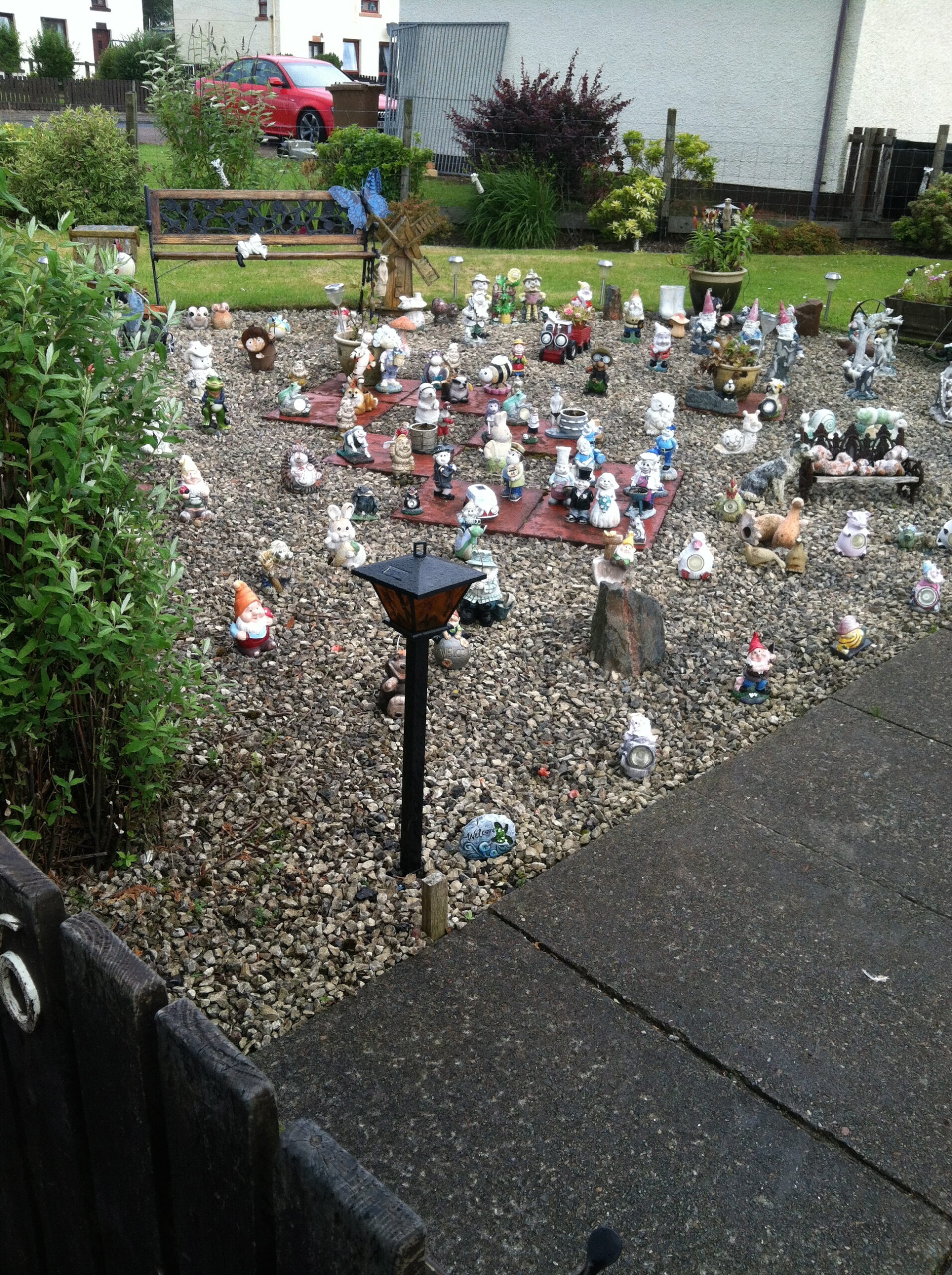
Garden Gnomes, Fort William, Scotland, 2014Garden gnomes are delightfully odd features of modern gardens. I’ve seen them in the US, Canada, Ireland, Scotland, England, and Wales, but the English win the prize for the most gnomish landscape. I snapped the photo above in 2014, just starting a walk up Scotland’s Great Glen Way. I suspect that the resident of Fort William, who has a front garden full of gnomes, probably grew up south of Hadrian’s Wall. . .

Only recently did I learn of an once-popular and frankly, bizarre fad that peaked during 18th century: having paid hermits reside on country estates. This practice may have led to the plaster-and-cement creatures we now tuck behind a small bush.

In short: landowners hired human beings to live like hermits on their property. Yes, hermits in rustic clothing who might abide in a grotto, a hut, or a cabin. To quote from the Wikipedia entry on the topic of garden hermits:

 Professor Gordon Campbell, of the University of Leicester, suggests that Francis of Paola was among the first of the trend, living as a hermit in the early 15th century in a cave on his father’s estate. He later served as a confidant and advisor to King Charles VIII.

Thus, a courtly hermit / advisor. Did he opine on garden design? Walking sticks? The placement of rocks in a grotto? Like so much else about this topic, the facts are simply lost to history.

I am looking forward to Dr. Campbell’s book A Hermit in the Garden: From Imperial Rome to Ornamental Gnome. The word “hermit” itself has ancient roots, back to Antiquity and recluses living in deserts and other wild places.  The OED notes that etymology spans back to the Greek ἐρημίτης< ἐρημία for “desert.” Hermits themselves abounded then; I think of John the Baptist, St. Simon, or further East, Buddhist or Hindu mystics and wanderers. Islam has its own tradition of wise-but-rustic philosophers; I even ran across hints of hermitry in the Icelandic Sagas.

I’ve covered Hobo here before; though we think of Hobo life as communal, in many ways they embody a mobile form of hermitage and a rejection of societal norms. One finds the thread picked up by the Beat writers who worked for a season or two in fire towers out West, or Edward Abbey’s and Terry Tempest Williams’ sojourns in the deserts of Utah.

Before finding Campbell’s book, I briefly considered researching the history of hermits as a retirement project; alas, it has been done for me. Besides, I would never come up with such a clever title. My copy is on the way now from Powells Books in Chicago, one of the nation’s great booksellers.

To recap this odd bit of history: we have, in Europe, a roughly three-century period when living as a hermit on an estate could be done in order to make a living. These ornamental hermits might entertain visitors or simply provide amusement by being observed. In return the hermit got a stipend, a hovel, and I presume, a new hair shirt from time to time.

During Thomas Jefferson’s residence in France in the 1780s, he had the occasion to travel to the north of Italy. His letters to friends reveal that he encountered at least two hermitages in formal gardens. One had a plaster figure of a hermit installed, and the other had once housed a human being who played the role. It seems the custom was falling out of fashion by 1790. The hermits themselves had become plaster figures, on their way to diminished statue as garden gnomes we can buy in Wal Mart’s garden section.

So where, exactly, did a wealthy landowner go searching for a hermit? I cannot imagine want-ads reading “sociable recluse wanted for rustic abode on great estate” but perhaps my imagination is too limited.

Moreover, why did keeping a hermit on salary fall out of favor? One wishes the custom had endured until the time of Downton Abbey, at least as a joke make by one of the family. But by the early 20th Century, hermitages and their denizens appear only in books and paintings. Visit Maymont locally; they have a grotto in the Italian garden. No hermit resides, but you will find a nice bench or two in the grotto and can play hermit until the staff expel you.

In the end, I gained a clue as to the origin of the garden gnome.  It endures, and even the word “hermit” has enjoyed a mild resurgence in use since the year 2000. Maybe in these utterly social (yet scary) times, some of us prefer the joys of solitude, though not in a premade grotto on some toff’s fancy estate.

Come out of your rustic abode to send me words or metaphors. I can be reached in my hermitage at jessid -at- richmond -dot- edu or by leaving a comment below.

See all of our Metaphors of the Month here and Words of the Week here.

Word of the Week! Dastardly

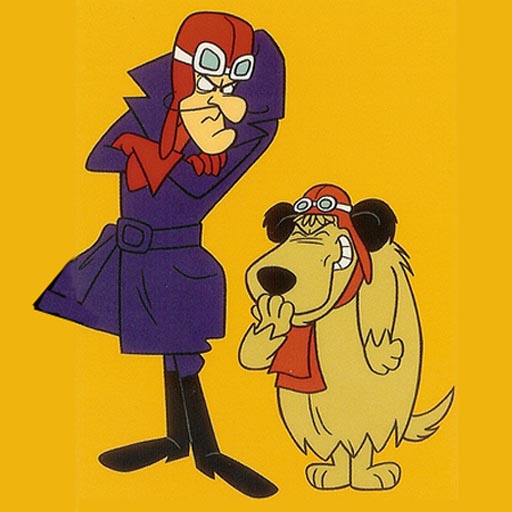
Dick Dastardly and MuttleyThanks to Josh Wroniewicz, Director, Business Office at our Campus Business Services, for this nomination. In election season, we usually have major candidates calling each other names. “Dastardly” would be a fine, if rather quaint, bit of mud to sling at one’s opponent.

Younger Boomers and older Xers will recall Dick Dastardly, a mustachio-twirling villain of the silent-movie sort, who appeared in a few Saturday-morning cartoons from the late 1960s onward. He says things such as “curses! Foiled again!” before being flattened like a pancake or blown up by one of his own traps.

Today I find the cartoons cringeworthy, save for the infectious laugh of Dastardly’s dog, Muttley (think of him as The Anti-Snoopy).  No, I cannot resist giving you a link to a short video of Dick’s and Muttley’s “best” moments. Despite this cornball association, the word retains a good deal of its antique power. Dick certainly fits a few obsolete meanings of our word, as given in the OED entry. He’s dull and stupid, at times, and when he hatches his hare-brained schemes, he usually acts in secret. Thus we get at a certain type of evil: done not openly but from under cover. This type of evil would not work with malevolent,” “sinister,” “diabolical,” or other terms for active, even gleeful, doers of evil.

The most common definition still in use would be “showing mean or despicable cowardice.” One OED example illustrates this nuance well, “The slanders of an avowed antagonist are seldom so mean and dastardly as those of a traitor.” The word comes from the 15th Century “dastard,” no longer used but of an interesting and possibly English origin.

That gives us a word far more inscrutable than the modern villain who takes its name.

The blog will continue all year, so send in useful words or metaphors, by e-mailing me (jessid -at- richmond -dot- edu) or leaving a comment below. You are invited to write a guest post as well.

See all of our Metaphors of the Month here and Words of the Week here.