Word of the Week! Moribund

Late Summer pasture

With classes about to resume on campus, the moribund time of late summer is about to end. Caveat: it ends for the students and those faculty and staff working next semester; I’m away from teaching until perhaps Spring 2027 as I finish some scholarly writing. My retirement, such as it is, has not been moribund at all, even as I get to savor the Golden Hour in September from my back porch, not through a car’s windshield on a commute.

“Moribund” has a dreary sound, doesn’t it? The OED entry notes it means “at the point of death; in a dying state, close to death,” and that certainly describes our summer vacation now. At the same time, I thought that it also meant “stuck or stagnant,” and the entry online has a second definition of “displaying such a lack of vigour or vitality that recovery appears impossible.” Right on the money, again!

I wonder if the use of our word has become moribund? It was first recorded in the early 1700s; usage peaked in 1950 and has suffered a steady decline that appears irreversible. Funny thing, that: we are now about about the same usage frequency as the year 1900. The 20th century, so vital and dangerous in many ways, also served as the period of popularity for the word. I’ll hazard a guess that the reading public had better vocabularies then. Reading for pleasure, in these frantic times, seems moribund.

I like the term, because of its dreary, deathly sound but I doubt we’ll see it spring back to life as a popular word, in my lifetime.

Set aside your back-to-school plans for a moment to send in words or metaphors worth covering. Email me (jessid -at- richmond -dot- edu) or leave a comment below. Want to write a guest entry? Let me know!

See all of our Metaphors of the Month here and Words of the Week here.

Image: Late Summer by Christian Kortum at Flickr.

Word of the Week! Conundrum

Whirlpool in ScotlandNow that my password is reset at UR and I’ve the two-factor app on my new phone, these posts can resume. I feel, however, that all of our technology has put us into a conundrum: what was supposed to make life simpler has led to many complications. Consider all the passwords you have to set, all the pop-up windows you have to close, ads to block, spam to filter.

This was not the promise of the Internet in the 1990s. Instead, we are faced with an unsolvable riddle, a dilemma, a paradox. In short, a conundrum.

Our word’s etymology merits a look. The Online Etymology Dictionary has this fascinating history:

“1590s, an abusive term for a person, perhaps meaning ‘a pedant;’ c. 1600, ‘a whim;’ 1640s, ‘pun or word-play,’ a word of unknown origin, said in 17c. to be Oxford University slang.”

I have never heard anyone called a conundrum, though I’ve known plenty of pedants and been called one myself. But we can see from the evolution in our word’s meaning how the sense of something that eludes an easy answer came to be.

As for our technology conundrums? Go analog more. Silence the phone. Ditch the Social Media conundrum of it promising to connect us but instead dividing us.

Get an ad blocker. Good luck!

As Summer wanes (thank goodness; I hate hot weather) and Fall semester resumes, send in words or metaphors worth covering. Email me (jessid -at- richmond -dot- edu) or leave a comment below. Want to write a guest entry? Let me know!

See all of our Metaphors of the Month here and Words of the Week here.

Image: The Gulf of Corryvreckan whirlpool in Scotland, From Wikipedia.

Word of the Week! Mogul

I strongly recommend that anyone in the area attend the exhibition “India’s Great Mughals: Art, Power, and Opulence” at the Virginia Museum of Fine Arts. It is yet another stunner from America’s finest state-run museum.

But this blog is not about museums; it’s about words. The wealth of the royal court of the Mughal empire seems distant now, unless one goes to the Taj Mahal or uses the word “mogul.” Dating from 1653 in the sense I wish to discuss, according to the OED, our term comes directly from the Anglicized version of “Mughal,” itself an Urdu word for “Mongol,” since the Mughals traced their ancestry back to Genghis Khan.

In our modern sense, this week’s word means a person of great wealth and power.

The OED’s most recent citation, from 1999, notes that Rupert Murdoch is “a television mogul.” We had movie moguls from the first half of the last century, then software moguls at the turn of the century, though (if I recall correctly) Neal Stephenson called them “software khans” in one of his science-fiction novels. I still prefer that term!

Today, amid the vast sums of money swirling around artificial intelligence, we have AI moguls. All of them, so far, are humans. At times I do wonder, but that would make another post.

The word’s frequency of use bottomed out in 2021 and then began a slow climb. We seem to be in a new era of moguls and their empires. Where it ends, no one knows. The Mughal Empire peaked and then experienced a series of bad leaders and overly lavish living, as its sphere of influence and power slowly withered.

Send me words and metaphors worth covering. Email me (jessid -at- richmond -dot- edu) or leave a comment below. Want to write a guest entry? Let me know!

See all of our Metaphors of the Month here and Words of the Week here.

Image: Shah Jahan and an gem. Who knew that he, like me, collected rocks? Image by me.

Word of the Week! Lyricosis

Creedence Clearwater RevivalWhile enjoying the July 4th holiday, outside if you can bear the heat wave, turn on some music. Then consider how you might mishear the lyrics to many a popular song.

“More than a woman,” a 70s hit, became “Bald-headed woman.” I can provide many more examples of lyricosis, or if you prefer Grammar Girl’s term, a Mondegreen, from a writer named Sylvia Wright who misheard a Scottish ballads’ words “and laid him on the green” as “And Lady Mondegreen.”

I have a feeling that lyricosis will outlive its rival, though the OED prefers Mondegreen, offering no entry for lyricosis, and dates Mondegreen’s first use to 1954. I disagree; “lyricosis” has the right root and affix to make it resemble a problem of the ears. “Mondegreen” is a bit too precious and obscure to catch on as slang when we are talking about Abba’s misheard lyric “Dancing Queen, young and sweet, only seven teeth.”

You youngsters might think lyricosis only afflicts those who listen to “Dad Rock” (as if The Ramones would ever qualify, after writing “Teenage Lobotomy“). I disagree: maybe the digital equipment plugged into your fully-functional ears does deliver crisper sound than radio or scratchy LPs, but if a singer slurs any words, you might suffer from lyricosis yourself. While I didn’t ask for AI help, it helped anyway during a Web search, noting that in Taylor Swift’s “Blank Space,” many hear “All the lonely Starbucks lovers” instead of “Got a long list of ex-lovers,” which seems a stretch but it is funny. That’s the point of lyricosis.

Our word is a neologism, much like musician Steve Miller’s term “Pompatus” that I covered here.

Remember, readers, at the cookout, don’t kiss a fly. `Happy Fourth of July.

Also don’t be afraid to send me misheard lyrics, or words and metaphors worth covering. Email me (jessid -at- richmond -dot- edu) or leave a comment below. Want to write a guest entry? Let me know!

See all of our Metaphors of the Month here and Words of the Week here.

Image source: Creative-Commons image of Creedence Clearwater Revival, looking for that bathroom on the right.

Word of the Week! Doohickey

Cat with computer parts

Editor’s Note: Reader Michael Stern authored this post for our summer enjoyment. Consider how many “doodad” or “doololly” or “doojolly” words relate to this neologism. Etymology Online does not give this origin but notes it to be an American neologism from 1914. Now on to Michael’s post.

Merriam-Webster’s Collegiate Dictionary defines doohickey as a “doodad,” which is itself defined as “an often small article whose common name is unknown or forgotten: gadget.” The OED defines it as “any small object, esp. mechanical; a ‘thingummy.” Neither offer a useful derivation but I happened upon what might be a reasonable and interesting one.

On July 9, 1776, Virginia patriots attacked Lord Dunmore and his supporters who were holed up on Gwynn’s Island in Chesapeake Bay. Embedded with the patriots was a French artillery captain who had joined the Continental Army. He built an experimental wooden mortar which was put to use in the attack, only to explode, killing him. He was the only casualty on the patriot side. His name was Dohicky Arundel.

Perhaps Arundel’s given name became a synonym for a nameless contraption (although more than a hundred years would pass before its first recorded use in Kansas Farmer in 1908, according to the OED.)

My source for this information is A Perfect Frenzy: A Royal Governor, His Black Allies, and the Crisis That Spurred the American Revolution by Andrew Lawler. My wife and I attended a lecture by Lawler at UR a few months ago and, needless to say, we purchased his book.

Send us words, thingamabobs, whatchamacallits, linguistic kluges, and metaphors worth covering. Email me (jessid -at- richmond -dot- edu) or leave a comment below. Want to write a guest entry? Let me know!

See all of our Metaphors of the Month here and Words of the Week here.

Creative-Commons Image: Sleepypete’s blog. Thanks, Pete. 

Word of the Week! Aeolian

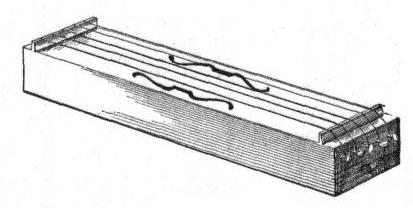
Aeolian harp

Even older than Achilles, the subject of my last entry, is the Greek god of wind, Aeolus.  From the god’s name we get our word, meaning an effect of the wind. In geology, it can mean wind-borne erosion. I’ve seen the word employed to describe features on the planet Mars, where NASA rovers are at work currently.

I first encountered the word, as “Eolian,” in an undergraduate class on the Romantic writers of England. Perhaps you know Samuel Taylor Coleridge’s 1795 poem “The Eolian Harp“? Take a peek. While it is not my favorite of his works, it certainly fixed the word we are discussing in my mind:

And that simplest Lute,
Placed length-ways in the clasping casement, hark!
How by the desultory breeze caressed,
Like some coy maid half yielding to her lover,
It pours such sweet upbraiding, as must needs
Tempt to repeat the wrong! 

At the time, many English were placing one of these wind-harps in an open window. The instrument is older still; Wikipedia’s entry on the harp cites a first description of it in the 1600s, but the instrument itself is ancient. You can find an interesting page on the harp’s history here. The OED notes that as a descriptor for a native of the Aeolian Islands, our word has a first recorded usage of 1546.

The passage of the wind would produce music quite different from a wind chime, though that too is an aeolian instrument (as compared to one that requires human breath to make music). In Coleridge’s era, there amounted to a bit of a craze for these devices, so romantics of all stripes could get one ready made.

Today it’s a bit harder to find one in Costco, so I recommend you build one. Kevin Busse offers some advice here for unusual designs that don’t require an open window. Other sites recommend building it to fit your casement. Here’s a favorite site, Fil Corbitt’s The Wind, with a page on various free-standing harps. Have a listen to the haunting melody from an “Obsidian Sky Wind Harp” (note: the harp has a high pitch, so turn down your volume at first!).

The blog will continue all summer, so send me words and metaphors worth covering. Email me (jessid -at- richmond -dot- edu) or leave a comment below. Want to write a guest entry? Let me know!

See all of our Metaphors of the Month here and Words of the Week here.

Creative-Commons image source: Wikipedia

Word of the Week! Muster

International space station crew muster

While on holiday in Digby, Nova Scotia we noticed a sign by a waterfront park: Muster Point. One such sign had also been on the Digby-Saint John ferry, which I have ridden a couple of times to avoid driving the long way around the Bay of Fundy when visiting my Canadian relatives.

My brain went back to militia musters of Colonial America,  where the citizen-soldiers would show up to drill, practice marksmanship, and get drunk. One hopes it was in that order!

On a ship it makes sense to have a designated place for crew and passengers to assemble, in case of emergencies. On land it seems less clear. Digby has the world’s largest scallop fleet. Perhaps the muster is for Coast Guard rescues?

While I never figured out why Digby has such a spot, I can at least share with you the term’s etymology. The Online Etymology Dictionary traces our word to Antiquity, with the Latin word monstrare, “to show,” which we see in our modern “demonstrate.” Later, the term evolved to indicate “show up” or “gather” and we have our militia showing up in the 18th century or crew gathering on deck in a crisis.

There is also a fine share of difference between a muster and assembly point. Read more about that here.

The blog will continue all summer, so muster your courage and send me words and metaphors worth covering. Email me (jessid -at- richmond -dot- edu) or leave a comment below. Want to write a guest entry? Let me know!

See all of our Metaphors of the Month here and Words of the Week here.

Image: crew muster aboard the International Space Station, NASA at Flickr.


Word of the Week! Sine Qua Non

BoethiusThree words this week, for the price of one. I find this term useful; though I don’t use it myself, I have seen it recently in long-form journalism. Wikipedia has an entire entry on it, so here are a few highlights. See that Wikipedia entry for its application in writing about medicine and the law.

Let’s get the definition out of the way: a mandatory precondition, an essential element, a key ingredient. The full Latin term is condicio sine qua non. So “today, a valid passport is a sine qua non of international travel,” or “to govern well at any level today, knowledge of macroeconomics appears to be a sine qua non for successful leadership.”

The origin is ancient, as we can tell from its Latin roots. That meaning, as given in Wikipedia “without which [there is] nothing,” appeared in the work of the early Christian philosopher Boethius. Earlier still, Aristotle used its Greek equivalent. For formal writing, I always like how a Latin phrase or Latinate word elevates the occasion, as does my taste for dress shirts and sometimes a tie when in the classroom.

What are some other expressions where our phrase might impress readers and make your prose more formal?  We simply lack good alternatives in English. “Must have” sounds blunt to me.

Summer break is a sine qua non for most academics and their students. So are frequent posts in a successful blog. As Spring turns to Summer and students leave for break, I’ll still be posting here. Send metaphors and words to cover by e-mailing me (jessid -at- richmond -dot- edu) or leaving a comment below. Want to write a guest entry? Let me know!

See all of our Metaphors of the Month here and Words of the Week here.

Image of Boethius from Wikipedia.

Word of the Week! Ephemeral

Wild Geranium in bloomSome words, like some wines, feel pleasant in the mouth. Our word is one of them; it has no sharp edges when present and when gone, it leaves a pleasant recollection.

The term’s etymology is Greek, “combined with an English element,” The OED entry reports. Dating from at least the 16th Century, it means transient or temporary. All things are temporary, if one takes a long enough view: the Blue Ridge Mountains once stood far taller. Yet “ephemeral” gives the sense of things that pass quickly, not durations of hundreds of millions of years. If you don’t pause to look, they are gone. Look at a cloud in the wind or the latest cultural fad. Here today, gone tomorrow?

I had always used the word in this sense until my wife began reminded me of the plants we see only at this time of year in flower. Our honey bees, as well as many native pollinators, love them. Soon we get hotter days and the grass grows taller, and our spring ephemerals vanish until next March and April.

If you look in a natural grassy area, instead of some chemically treated lawn, or in woodland area at this time of year, you may see many small flowering plants. These are the Spring ephemerals. Look for violets, the poorly named “Dead Nettle,” Virginia Bluebells, Dutchman’s Breeches, and more. I found a site about Northern Virginia ephemerals, a fine resource for an overdeveloped, overbuilt part of our state that, if you know where to look contains many lovely spots that have escaped the bulldozer’s blade.

Before it stops flowering, I’m going to toss some Dead Nettle along with Wild Onions I glean in a salad. It’s not only edible but purportedly has medicinal properties. Be careful where you forage in these days of overuse of lawn chemicals. We put none on the ground at our farm.

Some insects are know as ephemerals, too. They might live only a day. In the case of gnats, we can be thankful.

I’ll employ a cliche: some of the best things in life also are free and many are ephemeral. Slow down, put up the phone, and look. Enjoy while you can.

It costs you nothing to say our word or, if you know were to look, spot an ephemeral.

Send metaphors and words to cover by e-mailing me (jessid -at- richmond -dot- edu) or leaving a comment below. Want to write a guest entry? Let me know!

See all of our Metaphors of the Month here and Words of the Week here.

Image: Wild Geranium from Flickr, courtesy of Virginia State Parks.

Word of the Week! Shrinkflation

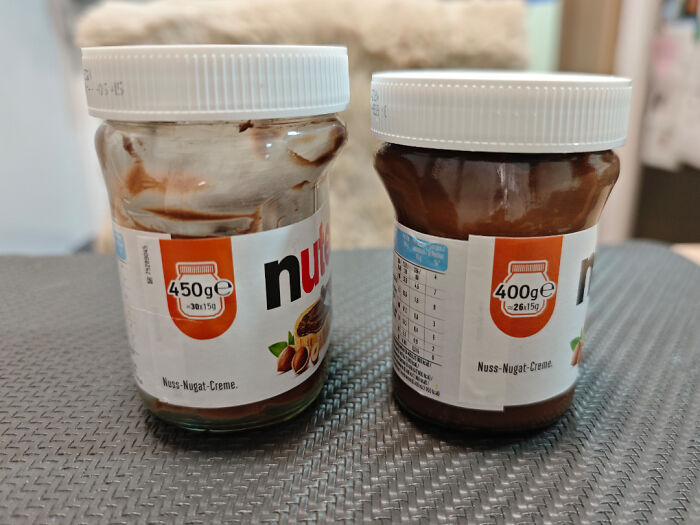
Nutella Jars, before and after ShrinkflationWe are in the process of switching brands for the dry kibble we feed our three livestock dogs. The dogs are huge, each over 100 pounds, and they eat a LOT of food. Our current brand, which I won’t name, began selling 38-pound bags for the same price as an older 50-pound bag.

It’s a good example of shrinkflation, a common problem visible to anyone who pays attention in the grocery-store aisles. You can read all about the economics of this portmanteau word at Wikipedia, but I’m curious about the term’s origin. The Online Etymology Dictionary was of no help, but a Stack Exchange discussion led to a possible first use in 2014. There’s a precedent, too, in the term “stagflation,” a bogeyman of 1970s economics.

Is this post shorter than last week? Since it costs you nothing but time to consume a post, it’s not shrinkflation. I simply found myself taciturn and grumpy this week about that dog food!

Send metaphors and words to cover by e-mailing me (jessid -at- richmond -dot- edu) or leaving a comment below. Want to write a guest entry? Let me know!

See all of our Metaphors of the Month here and Words of the Week here.

Creative-Commons Image: Ink.com. I’m not a Nutella fan, either.